

Does Collagen Help Build Muscle? A Quick Research Overview
Collagen is a popular “anti-aging” supplement for maintaining skin elasticity, keeping our joints strong, and helping our connective tissues recover. So far, the research has been modestly positive and fairly consistent (study, study). Collagen appears to support tendon, bone, joint, and skin health.
Lifters often run into nagging aches and pains in their joints and tendons. Supplementing with collagen appears to be a reasonable way to improve recovery. And it is. Collagen enhances the tendon and joint adaptations we already get from weight training (study, study). That raises an obvious question: what about muscle growth? Does collagen help build muscle?
Jacinto and colleagues compared whey protein against collagen peptides, seeing which yielded more muscle growth. It’s a neat study. We’ll go through it. And then we’ll go into the rest of the research.
What is Collagen?
Collagen is the most abundant protein in your body, providing structural integrity to your skin, hair, nails, bones, tendons, ligaments, cartilage, and blood vessels. Since collagen is found in connective tissues and skin, the natural way to include it in your diet would be to eat more connective tissues and skin, such as:
- Bone Broth: Made by boiling animal bones and connective tissue. The long cooking process breaks the collagen down into gelatin, which dissolves in the broth.
- Tough Cuts of Meat: Some cuts of meat, such as brisket and shank, are tough from all the connective tissue they contain. You can cook slow-cook or stew them, breaking the connective tissue down into collagen.
- Fish Skin: The skin and scales of fish are rich in collagen.
- Chicken Skin: Like fish, chicken skin is high in collagen, too.
- Organ Meats: Organ meats like the liver, heart, and kidneys contain a little collagen.
If you want to add even more collagen to your diet, you could cook with gelatin or supplement with collagen protein. Collagen supplements are made by breaking collagen down into peptides via hydrolysis, so we call them “collagen peptides” and “hydrolyzed collagen.” They’re effectively the same. You can use either one.

Collagen is A Strange Protein
Collagen has a unique amino acid profile. On one hand, the presence of glycine, proline, hydroxyproline, and hydroxylysine makes it good for collagen synthesis, which can improve the health of bones, tendons, and other connective tissues.
On the other hand, collagen is low in leucine, isoleucine, valine, lysine, and methionine, which are key amino acids for muscle-protein synthesis. As a result, you’d expect collagen to be good for your body but bad for building muscle.
However, our bodies are fairly flexible. We can build muscle remarkably well even when consuming “sub-optimal” protein sources. For example, when lifters bulk on a plant-based diet, their protein sources are less complete, yet they tend to build muscle just fine, provided they eat a good bulking diet and consume enough protein overall.
This is all to say that before seeing the results of this study, I didn’t know whether collagen would be good for building muscle. It could have gone either way.
Collagen Increases Lean Mass
Some research shows that collagen can help us build denser bones, tougher tendons, and stronger connective tissue. All of those things count as “lean mass.” As a result, some collagen studies show increases in lean mass (study, study).
However, gaining lean mass isn’t the same as building muscle. To know if collagen helps us build more muscle, we need to look at a study that measured actual muscle growth.
Whey Protein vs Collagen: The Jacinto Study
Jacinto and colleagues put a group of participants on a 10-week hypertrophy training program designed to stimulate muscle growth (study). After their workouts, half of the participants had a collagen protein shake, and the others had a whey protein shake. Both shakes contained 35 grams of protein.
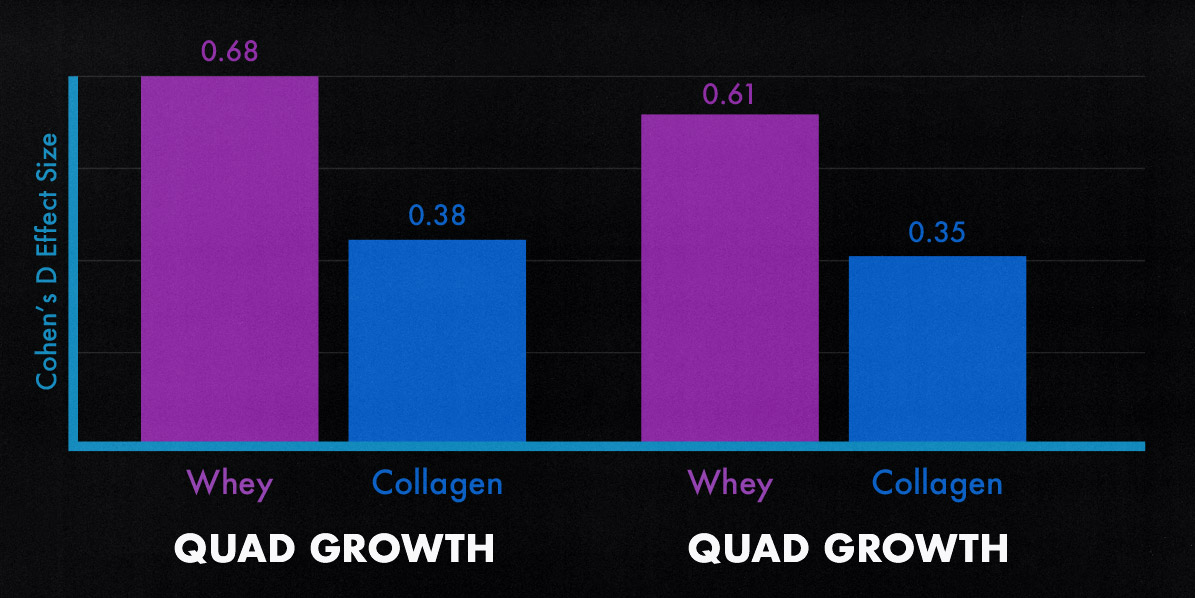
After 10 weeks, the group supplementing with whey protein gained significantly more muscle than the group using collagen.
The obvious takeaway is that collagen isn’t very good for stimulating muscle growth. If you’re trying to support muscle growth, you’d want to use almost any other source of protein instead.
The less obvious takeaway is that collagen is so good at improving collagen synthesis that it causes measurable gains in “lean mass” in your tendons, cartilage, skin, and bones. That won’t make you stronger, but it will make you faster, less likely to get injured, and look younger.
What I Do
When I’m bulking, I eat 4 big meals per day, each with a hearty source of protein. If I’m short on calories, I have snacks. I don’t worry too much about whether those snacks have protein. This brings my daily protein intake up to 0.7–1 grams of protein per pound of body weight per day. That’s more than enough to maximize my rate of muscle growth. I’m covered.
When I first started jogging for cardiovascular exercise, I got shin splints. I had heard that collagen could help, so I mixed 20 grams of collagen into warm water and then squeezed in some lime juice for vitamin C. The reason I had collagen before running is to pump the collagen into the areas I was exercising. The reason I added vitamin C was to improve collagen synthesis (study, study, study).
When this new research started coming out, I decided to keep collagen in my daily routine. I have 15 grams per day. If I’m exercising that day, I’ll have it 30–60 minutes before working out.
If you care about having youthful skin, most research points to exercise being more effective than collagen supplementation (study). Lifting weights and cardio both help, but weights seem to be slightly better. But if you add collagen supplements on top of exercise, the benefits seem to stack, giving you even better results.
Conclusion
Collagen doesn’t have the amino acids that directly support muscle growth, but it’s still an important part of a balanced diet. If you aren’t eating much tendon, skin, or organ meat, it can make sense to supplement with it. I’m impressed enough by the research that I have 15 grams of collagen every morning, along with a source of vitamin C.
- If you’re having a pre-workout protein shake, collagen might be a good choice. It won’t help you build muscle, but the exercise will help the collagen get into the connective tissues and joints you’re training.
- If you’re having a post-workout protein shake, use a complete source of protein. That could be whey protein, a plant-based protein blend, or a smoothie with some Greek yogurt. That will be better for helping you build muscle.

If you want to learn more about everything related to health and aesthetics, check out our Legends Program. We’ll show you how to optimize your diet, lifestyle, and exercise routine for aesthetics, strength, longevity, and healthy aging. You’ll look better, feel younger, and get way stronger.

Shane Duquette is the founder of Outlift, Bony to Beastly, and Bony to Bombshell, each with millions of readers. He's a Certified Conditioning Coach (CCC), has gained 70 pounds, and has over a decade of experience helping more than 15,000 people build muscle. He also has a degree in fine arts, but those are inversely correlated with muscle growth.

Marco Walker-Ng is the founder and strength coach of Outlift, Bony to Beastly, and Bony to Bombshell. He's a certified trainer (PTS) and nutrition coach (PN) with a Bachelor's degree in Health Sciences (BHSc) from the University of Ottawa. He has over 15 years of experience helping people gain muscle and strength, with clients including college, professional, and Olympic athletes.