

Jeremy Ethier’s Bulking Advice: Bad Science, Fake Transformations & False Accusations
Jeremy Ethier just released a video about bulking with fake transformations, incorrect scientific references, and a strange accusation against me. I suspect Jeremy’s intentions are good. I think he’s trying to give people realistic expectations. However, I think it’s wrong to use fake transformations as an example of “realistic” results, especially when he’s incorrect about what’s realistic.
I’ll link the studies he references, and you’ll be able to see right away that they suggest the opposite of what he says they do. I’ll also go through his bulking recommendations, explaining why they’re wrong and don’t work very well for skinny guys.
The accusation is stranger. Jeremy put on a wig of my haircut and attacked a couple of the claims I’m known for making:
- Claim 1: I gained 20 pounds quite leanly in 3 months. Jeremy says this is physically impossible without steroid abuse, and therefore I must be lying (or abusing steroids). This is false. I’ve done it myself, I wasn’t the first, and I’ve had quite a few skinny clients get similar results. They tend to be tall and underweight.
- Claim 2: It’s realistic for the average skinny guy to gain 20 pounds quite leanly in 6 months or less. Again, Jeremy claims this is physically impossible. He says it takes at least a year for a skinny beginner to gain 10–20 pounds of lean mass naturally. This is false, and in a way that’s much easier to show, since it’s fairly common for skinny beginners to build muscle faster than that.
I made a video response, but I want to go a bit deeper in this article, including answering all of the common questions I got after posting the video. I answered 400 comments underneath the video, and I’m happy to answer more—that’s my favourite part of YouTube—but I think it would pay to go into greater detail here.
Note: bulking slowly is perfectly fine. The gains you leave on the table won’t rot. You can have them later. However, Jeremy Ethier’s video was “The Fastest Way to Gain 20 Pounds of Muscle Naturally,” so that’s what this article is about.
I remember what it felt like to be a skinny guy who wanted to bulk up fast. If that’s what you want, too, then I want to help you do it properly.
Jeremy Ethier’s Strange Accusation
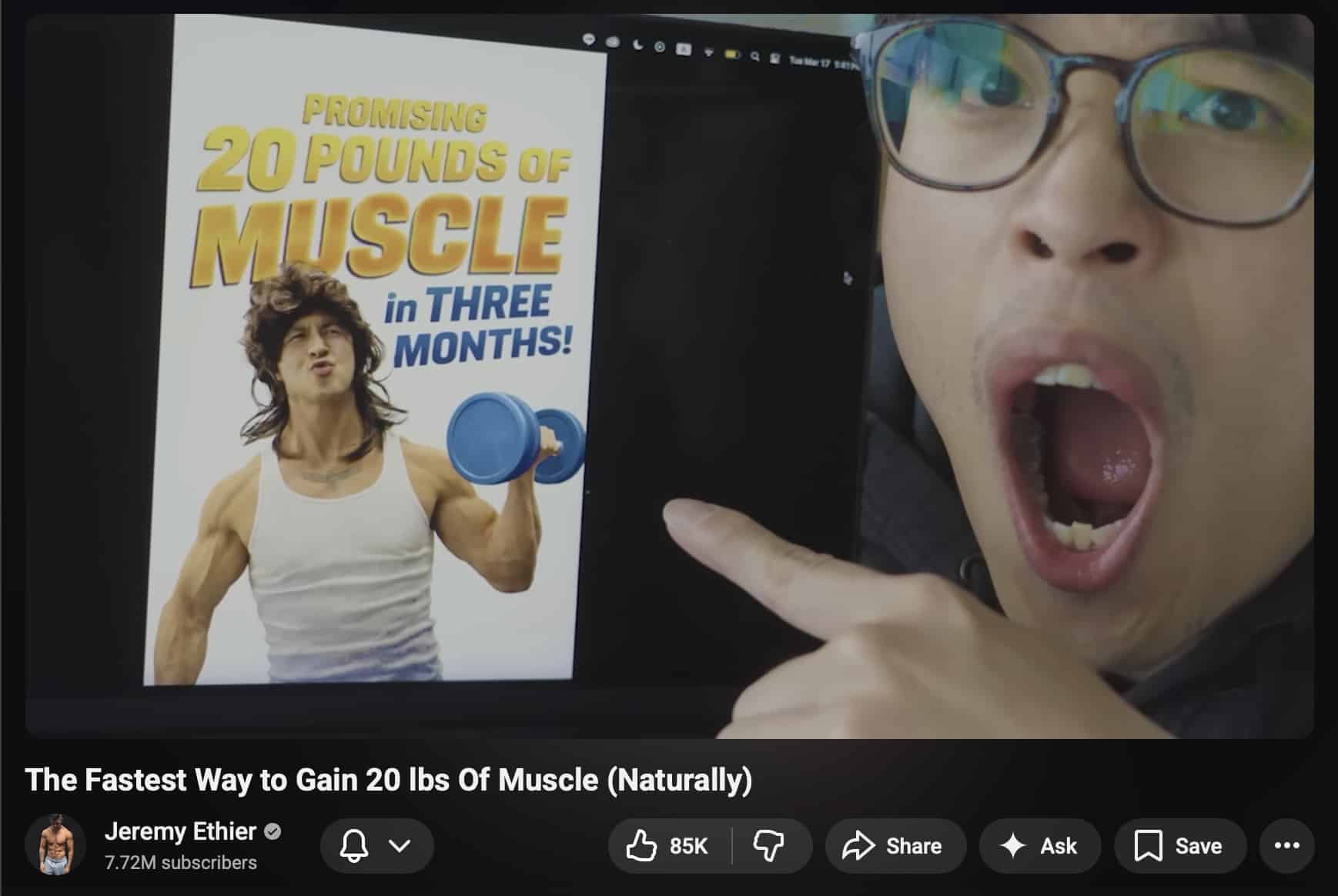
In Jeremy Ethier’s video “The Fastest Way to Gain 20 Pounds of Muscle Naturally,” he says it’s impossible to gain more than 20 pounds of muscle in a year, and that anyone who claims otherwise is being dishonest. While saying that, he puts on a wig and positions himself next to a claim of gaining 20 pounds of muscle in 3 months. Here’s a screenshot from the video:
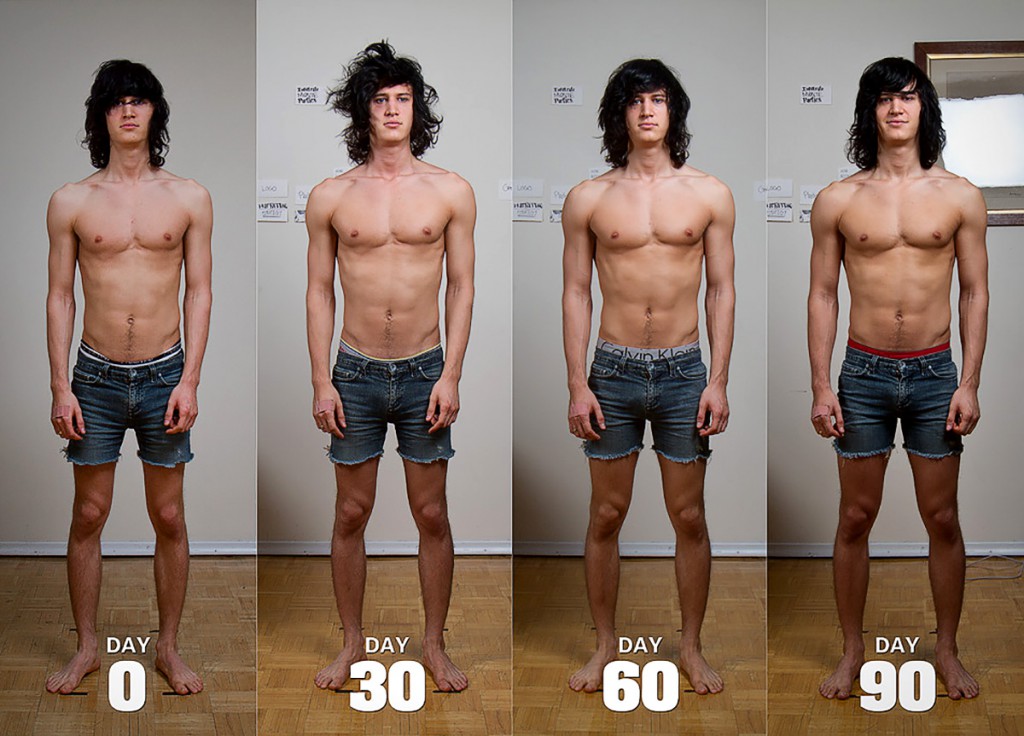
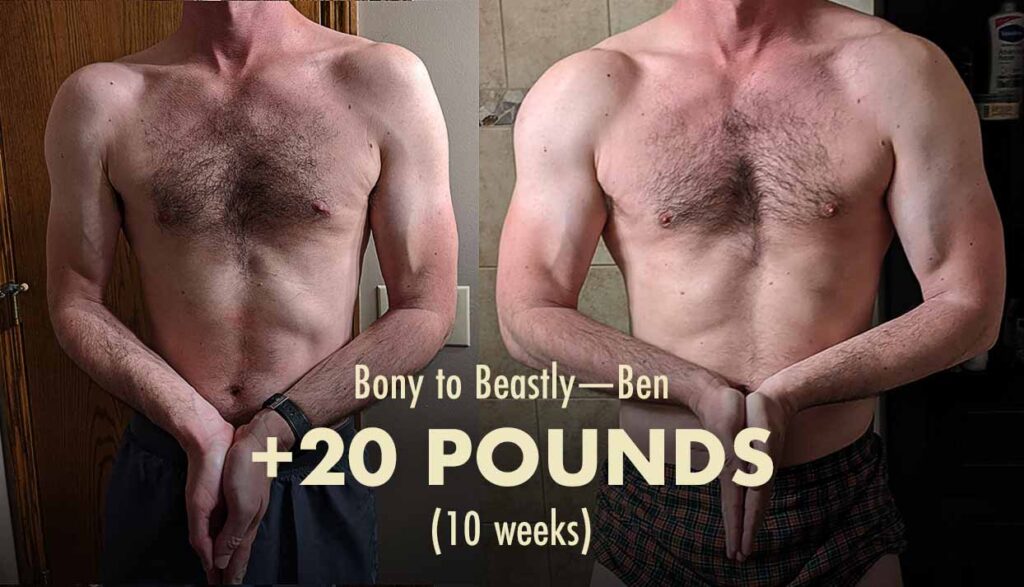
It’s weird to say this, but it seems like Jeremy Ethier is dressed up as me. It could be a coincidence that his wig looks like the haircut I had. I’m not sure. But these are my progress photos from my second bulk, showing me going from 150 to 175 pounds, gaining 25 pounds in 3 months:
If that’s all there was, I’d say it was a coincidence. But if you do an image search of how long it takes for a skinny guy to gain 20 pounds of muscle, my progress photos are the very first result:
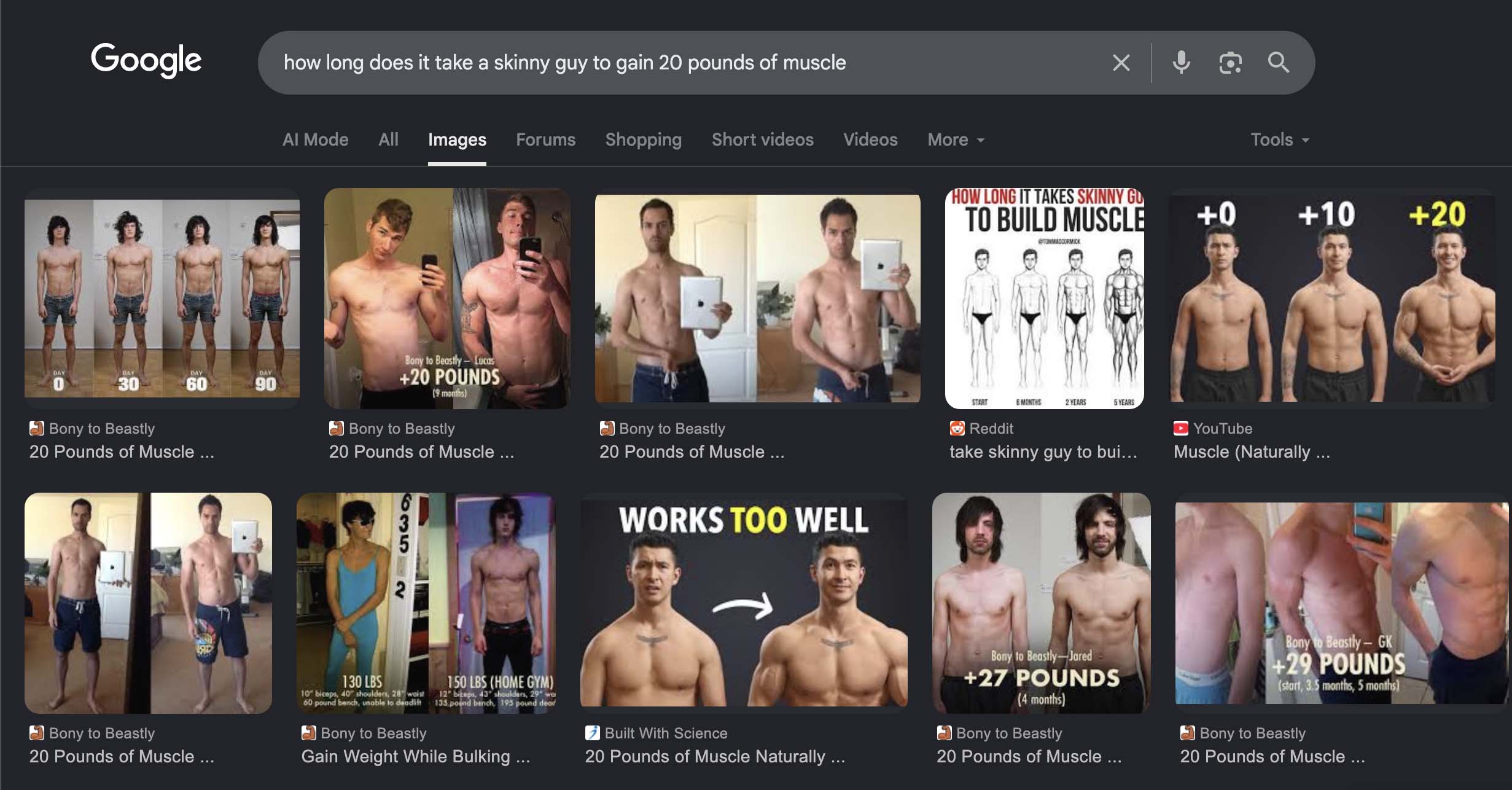
The second and third results are clients of mine, Lucas and Obe. The fourth result is what appears to be a fake transformation of Jeremy Ethier gaining 20 pounds. The fifth result is another of Obe’s progress photos. The sixth result is my first bulk, showing me going from 130 to 150 pounds, gaining 20 pounds in 3 months. After that, there’s another of Jeremy Ethier’s fake transformations. Then my business partner, Jared, gaining 27 pounds in 4 months. And finally another client of mine, GK.
If you go to look for an article, the AI references my blog posts over and over again. I think it’s getting most of its information from scraping this Bony to Beastly website:
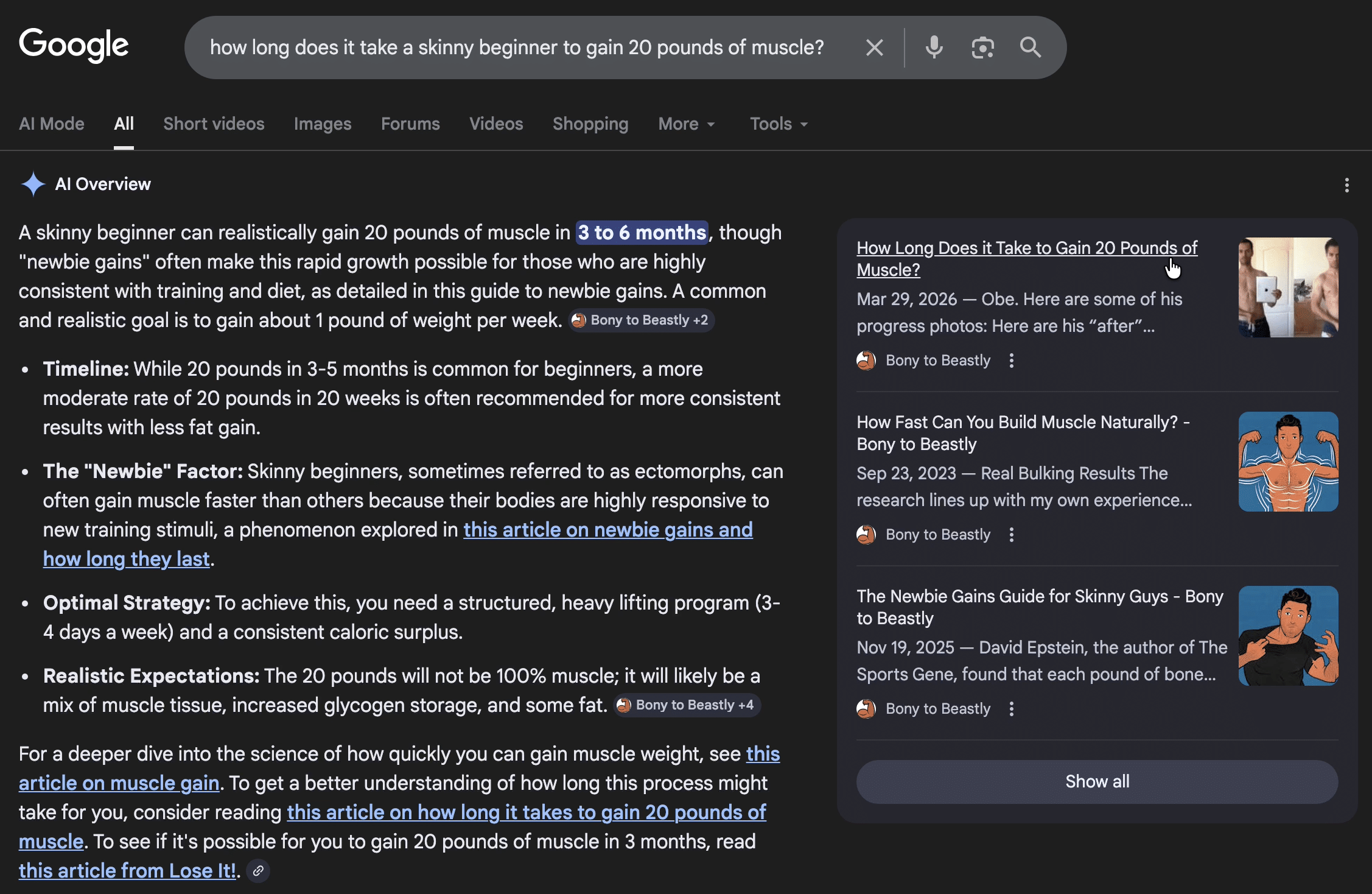
I don’t think I’ve ever claimed to have gained 20 pounds of muscle in 3 months, but I’ve definitely gained 20 pounds of weight in 3 months, and those gains seemed fairly lean. It looked kind of like I had gained 20 pounds of muscle:
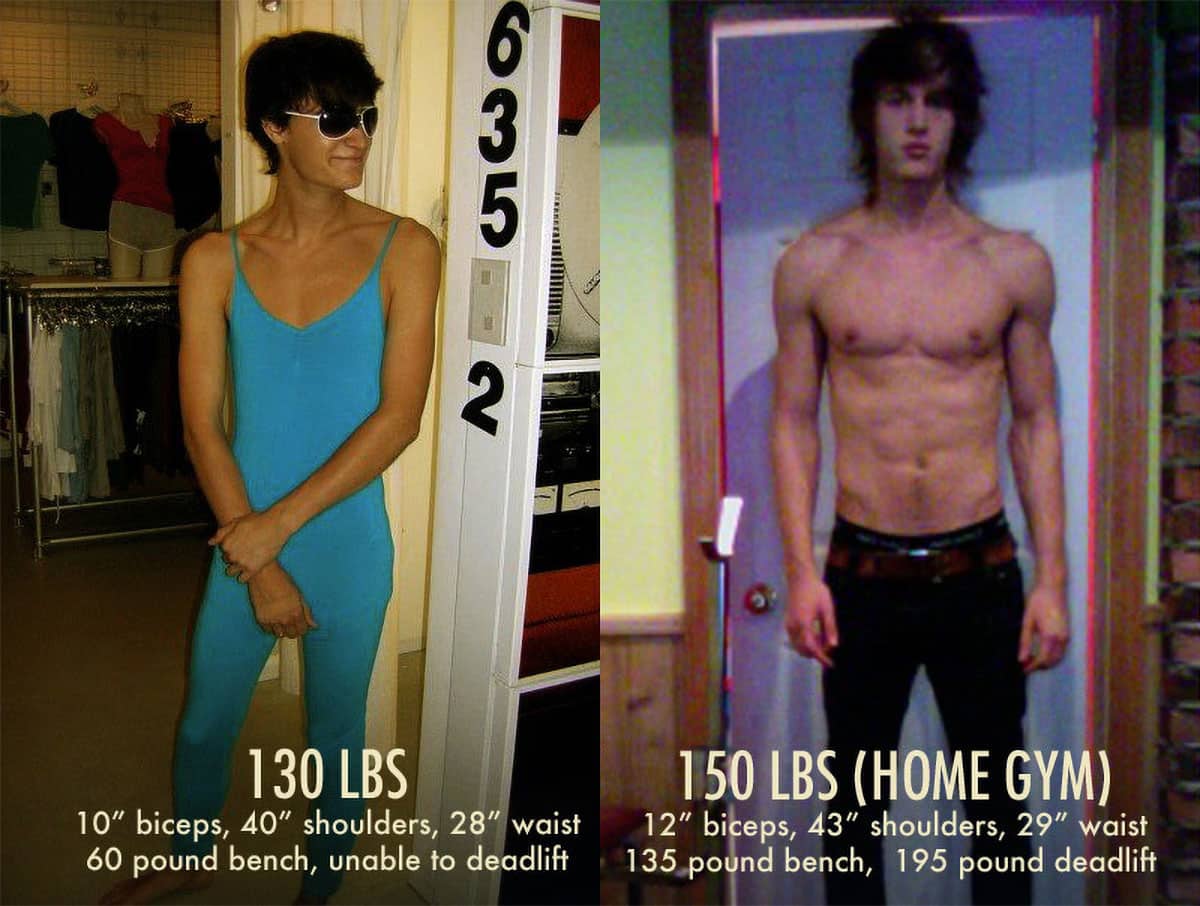
It gets confusing because Jeremy Ethier doesn’t make much distinction between weight, lean mass, and muscle. When he shows his own personal transformation, he’s talking about weight. When he talks about the research, he’s talking about lean mass. But no matter what he’s talking about, the word he uses is “muscle.”
I think he’s suggesting something like this: because my gains appear to be completely lean, and because I gained 20 pounds on the scale, I gained 20 pounds of “muscle.” He thinks it’s physically impossible to gain muscle that quickly, so I must be dishonest.
Jeremy Ethier and I also have a little bit of history. This is the second time he’s made a video about how fast you can build muscle. The last time he made this same video (here), he used my drawings for his graphics:
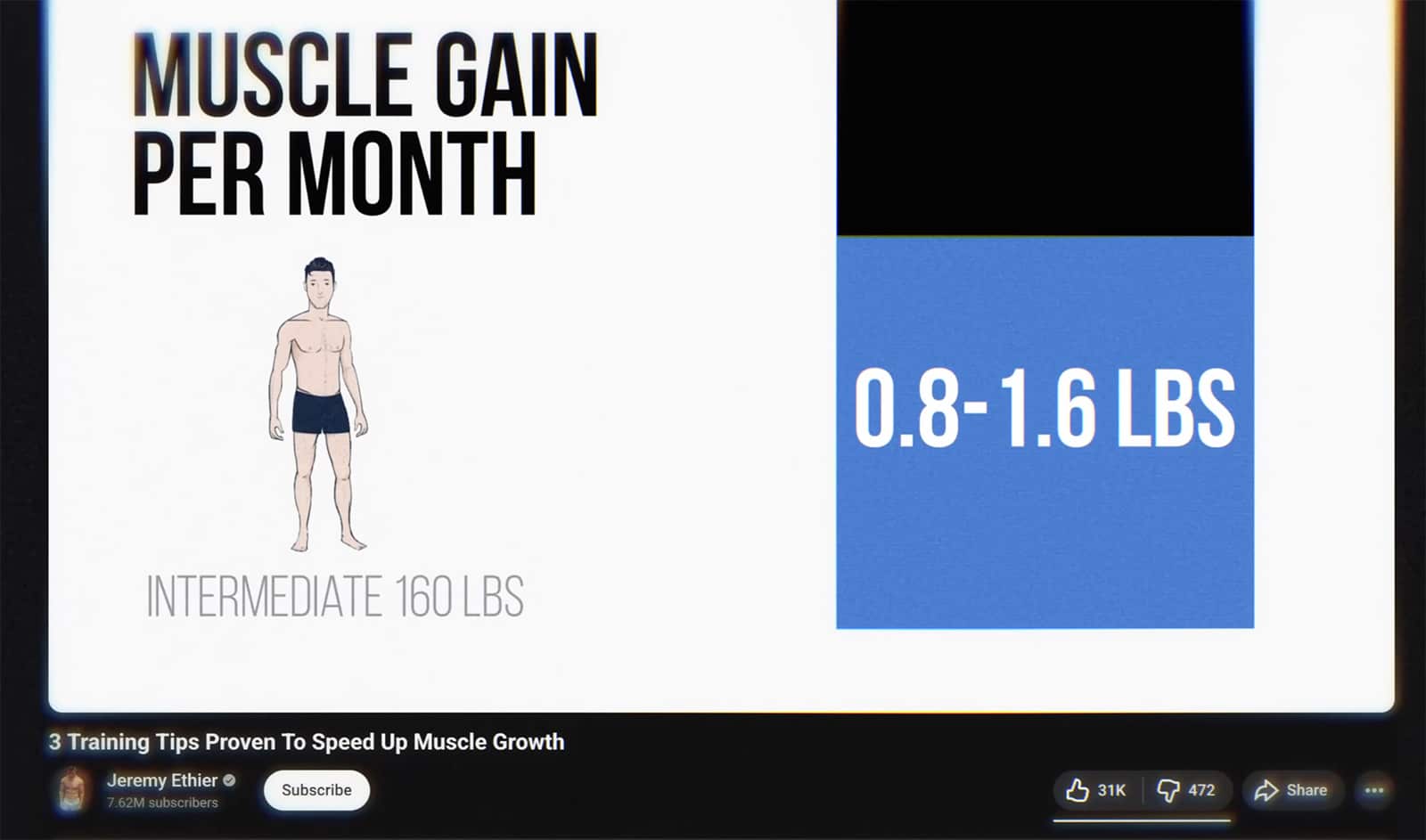
I don’t mind when people use my art, but he didn’t credit me for it, so it seemed as if he was the one who was making them, and I was the one who was copying him. I asked him if he could give credit, and he was nice about it. Then he started tracing my art:
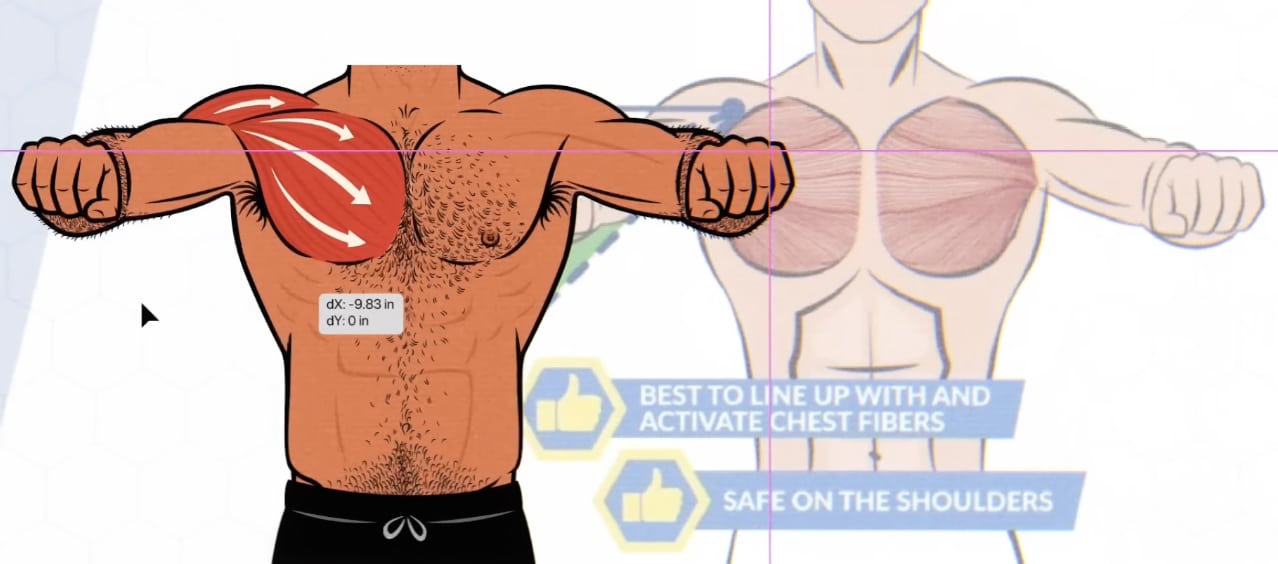
That’s my drawing on the left and his tracing on the right. In the video, he also animated in those same arrows I used to show the direction the muscles are pulling.
I spoke with Jeremy about it again, and he was nice again. He explained how he was sending my articles to his graphics team as a reference. That drawing comes from my article breaking down the bench press.
Now Jeremy uses AI-generated graphics. Strangely, he also uses AI to generate fake progress photos.
Fake Progress Photos
In this bulking video, Jeremy Ethier uses video footage of real people, but then he uses AI to generate fake after photos, showing them gaining muscle they never gained. Here’s the example he uses of a skinny guy gaining 20 pounds of muscle:
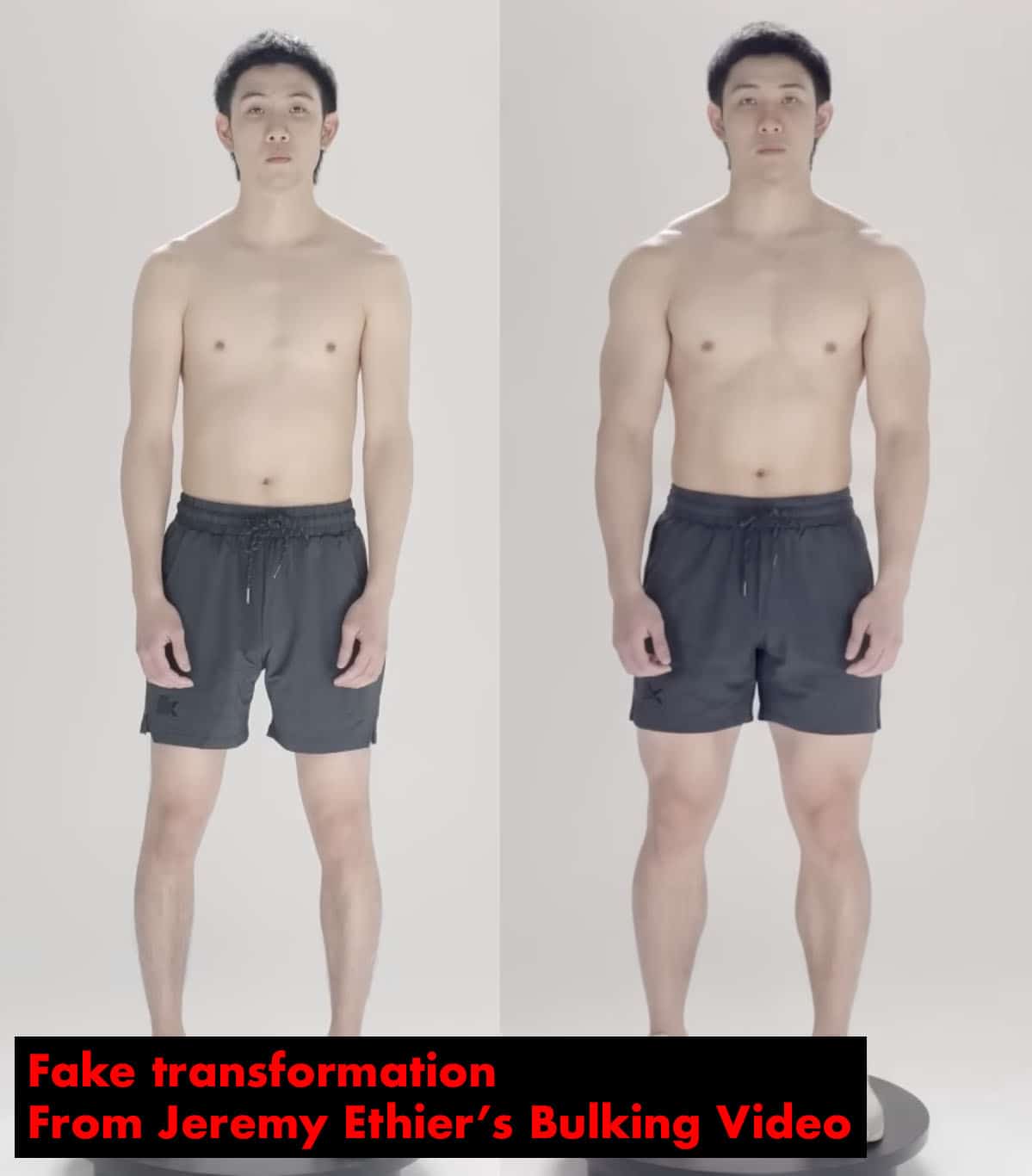
I think it’s supposed to be obvious that the results he’s showing are fake. However, when you post AI content on YouTube, you’re supposed to disclose it, especially when you’re showing realistic things that didn’t really happen:

I don’t see any AI disclosure on his video. It’s supposed to be disclosed here, but it isn’t:
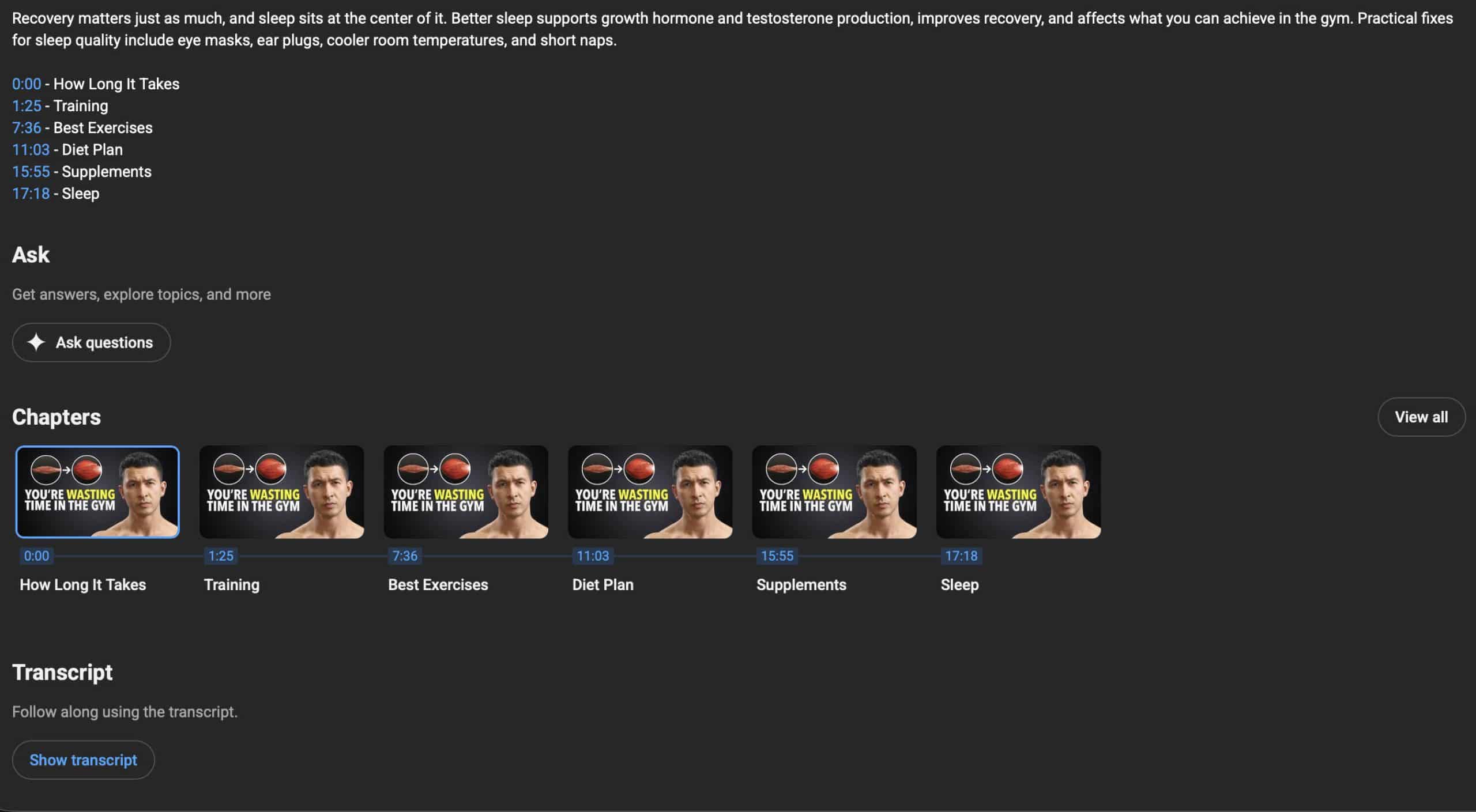
He’s claiming that his methods can help someone gain 10–20 pounds of muscle in a year, but he doesn’t show a single real example of his methods actually working. It’s all fake. That creates a strange situation where he’s saying our expectations should be more modest, but he doesn’t show a real example of someone making even modest gains.
Jeremy Ethier’s Incorrect Scientific References
“Only 5% of People Ever Gain 20 Pounds of Muscle”
The first reference Jeremy Ethier uses is this study by Kudsk and colleagues, but it’s an incorrect reference. Jeremy says: “Based on an analysis of 16,000 Americans, less than 5% of people ever gain 20 pounds of muscle naturally. Not because of age or genetics, but because without the right plan, you might make some progress early on, but afterwards you get stuck, spending years with the same physique. And more protein, more creatine, and more workouts won’t help you break through that.”
If you read the study, you’ll see right away that it couldn’t possibly support the claim he’s making. It’s a cross-sectional study, which means the researchers took one measurement of the participants. They didn’t track any body composition changes over time. The researchers didn’t measure whether people gained muscle. They just estimated how much lean mass the participants had in that one moment. There’s also no indication that the study participants had ever tried to build muscle.
I spent a few hours trying to figure out how Jeremy could make a mistake like that, and I think he’s comparing the 50th percentile against the 95th percentile. If we assume typical height, the 95th percentile is about 20 pounds more muscular than the 50th percentile. However, there’s no reason to think the top 5% are the guys who tried to build muscle and succeeded, whereas the bottom 95% are guys who tried and failed. All the study says is that 5% of people have 20 pounds more muscle than the typical man.
(The mistake goes beyond bad science. Jeremy Ethier is giving examples of skinny guys, but he’s clearly assuming you’re starting off with a typical amount of muscle. The scientific reference is totally wrong, so it doesn’t matter here anyway, but the assumption causes bigger problems later.)
Using this study, Jeremy could have said: “If you start with an average amount of muscle, and if you gain another 20 pounds on top of that, you’ll be in the top 5% of people your height.” There’s no negativity to that statement, though. There’s no suggestion that you need Jeremy Ethier’s special bulking methods to escape the pit of failure.
I checked this with Jeremy Ethier’s Chief Science Officer, Dr. Eric Trexler, who’s featured in another section of the video. He said that my interpretation of Jeremy’s error appears to be correct. He told me he wasn’t consulted on any of the claims outside of his section of the video, and that he isn’t defending their accuracy.
Regarding Jeremy Ethier’s main claim, Dr. Trexler told me, “Regarding the idea that you can’t gain 20 pounds of lean mass in under a year because ‘muscle just doesn’t work like that’—probably just referring to normative data regarding rate of muscle growth at the sample level.”
However, Jeremy Ethier also cited the normative data incorrectly.
“You Can Gain 10–20 Pounds of Muscle in a Year”
Jeremy Ethier references Benito and colleagues to prove that you can definitely gain at least 10 pounds of muscle, but not more than 20 pounds. This is the normative data Dr. Trexler was referring to, and this is the study that’s commonly cited. However, it doesn’t in any way support Jeremy’s claim.
Benito conducted a meta-analysis to see how much muscle people tended to gain from just weight training. This isn’t a meta-analysis about building muscle or bulking up. To build muscle, you also need a diet and lifestyle that supports muscle growth. To bulk, you need a calorie surplus.
Most of the studies included in this lifting meta-analysis showed just a couple of pounds of muscle growth: 3.4 pounds on average. Because longer studies didn’t show greater muscle growth than shorter ones, Benito concluded that weight training causes about 3.4 pounds of muscle growth, regardless of how long the intervention lasted.
That means Jeremy Ethier is wrong in two ways:
- Jeremy claims you can expect to gain 10–20 pounds of muscle in a year, but to prove his point, he cites a study showing you can expect to gain 3.4 pounds. That doesn’t support his claim.
- If Jeremy believes you can exceed the rates of muscle growth in this study by following his methods, including a bulking diet, lifestyle changes, and supplements, then this study no longer gives an upper limit to how much muscle you can gain in a year.
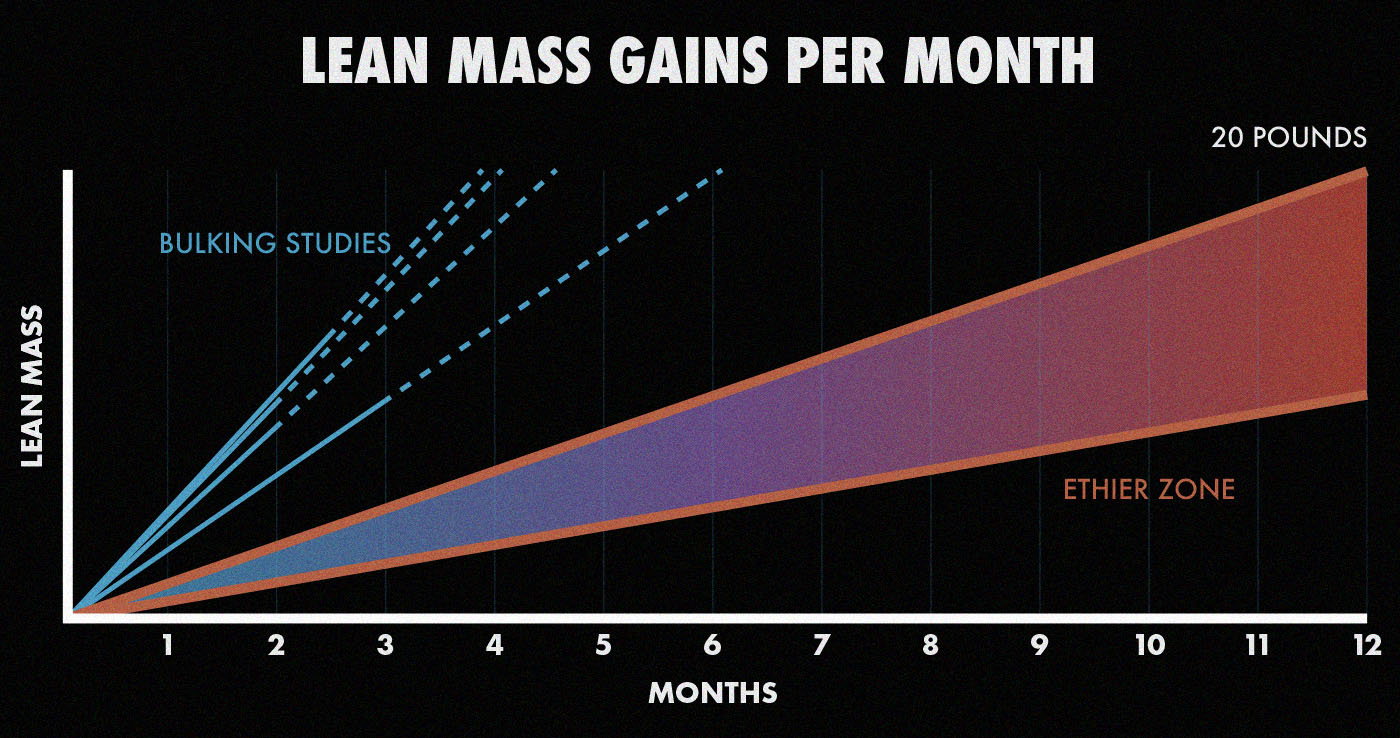
There are proper bulking studies Jeremy could have referenced, but they would have disproven his claim. In these studies, the researchers combined weight training with a diet designed to support muscle growth, and the participants were in a calorie surplus:
- 9 pounds of lean mass in 12 weeks: In a study by Hartman, guys gained 9 pounds of lean mass and lost 2 pounds of fat during their first 12 weeks of lifting weights and drinking more milk (study). That was the average rate of growth in the study, not the most you can possibly gain. One guy drinking soy milk gained 17 pounds of lean mass in 12 weeks.
- 9 pounds of lean mass in 8 weeks: In a study by Tarnopolsky, guys gained 9 pounds of lean mass during their first 8 weeks of working out and drinking mass-gainer shakes (study). Again, those are the average results, not any sort of physiological limit.
- 12 pounds of lean mass in 10 weeks: In a study by Willoughby, guys gained 12 pounds of lean mass during their first 10 weeks of weight training and supplementing with protein (study). Interestingly, Willoughby has been skeptical of the rates of muscle growth seen in other studies.
- 8 pounds in 8 weeks: In a study by Rozenek, guys gained 8 pounds of muscle and 0 pounds of fat during their first 8 weeks of lifting weights and supplementing with mass gainer shakes (study).
If the study participants had kept gaining at the same rate, it would have taken them 4–6 months to gain 20 pounds of lean mass:
I intentionally chose studies Jeremy Ethier should have known about. That Willoughby study is in the Benito meta-analysis he cited. If he had gone through it properly, he would have seen an example of people building muscle faster than he claimed was possible.
Jeremy Ethier also brought on the bulking researcher Dr. Eric Helms, who explained how in the Rozenek study, the participants gained a pound of lean mass per week. Dr Helms has also referenced the other studies and/or research teams in his research review, Monthly Applications in Strength Sport.
That brings up another problem with Jeremy’s bulking advice: muscle growth isn’t linear. People don’t steadily gain a pound of lean mass every week. If these studies had been longer, I think we would have seen diminishing returns over time. I think that’s where Jeremy Ethier’s recommendations get worse. I’ll get to that in a moment.
Skinny People Can Build Muscle Faster
There are a few factors that play into how fast you can build muscle, but the most important factor is how much room you have on your frame for muscle growth. Think of your bone structure like a bookshelf, and think of muscle like books. The bigger your bookshelf is, the more books it can hold.
When people hear that, they think people with bigger frames can gain more muscle, but that isn’t what it means. People with bigger frames tend to start with more muscle. Their bookshelves are bigger, but those shelves are already rather full. You can’t add tons of books to a bookshelf that’s already almost full.
What this analogy means is that if your bookshelf is empty—if you’re skinny—then there’s still plenty of room for books. If your bookshelf is huge, great, but you won’t be butting up against that limit any time soon anyway. Even if your frame is small, you’ll be able to pack on muscle quite fast, at least while you’re getting your newbie gains.
Jeremy Ethier understands this, but only halfway. He showed a chart like this one:
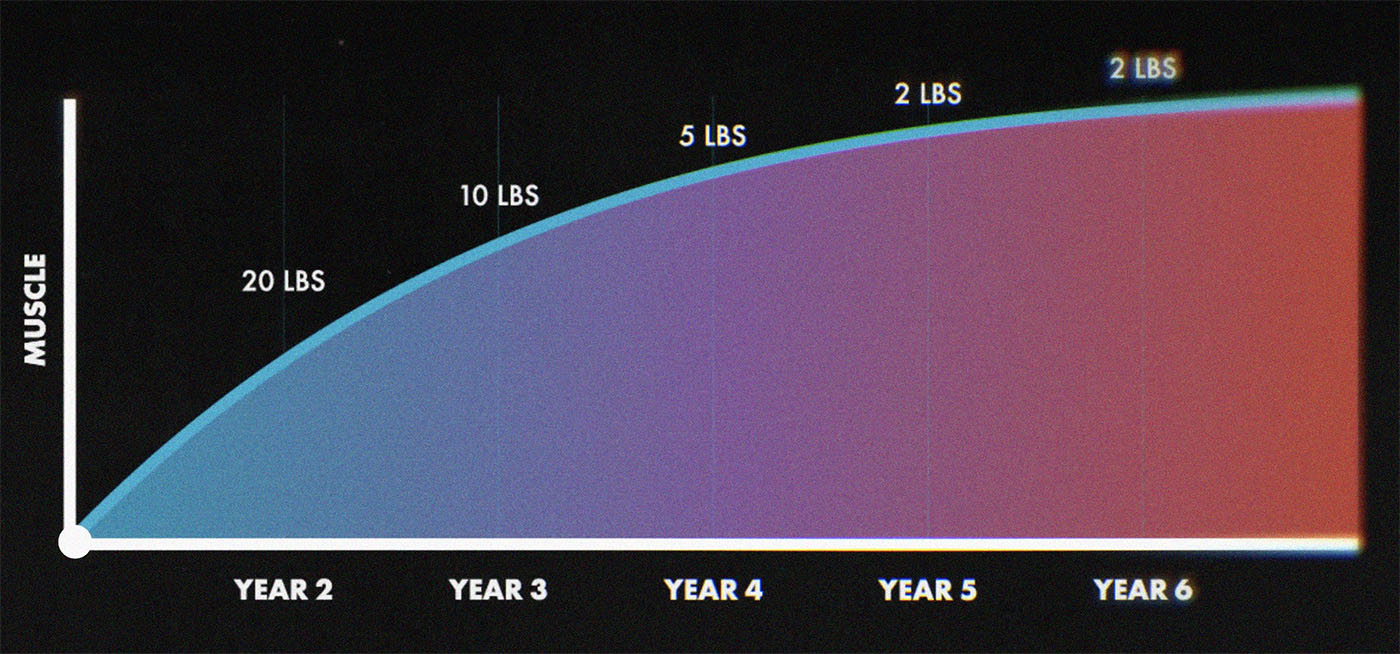
This idea is about 15 years old, coming from Alan Aragon or maybe Lyle McDonald. It survived this long because it’s often true. But it isn’t supposed to guarantee you can gain 20 pounds of muscle in a year, and it isn’t supposed to show that it’s impossible to gain more.
Rather, it’s supposed to show that if you pluck an athletic 20-year-old off a college campus, he’ll probably be able to gain 20 pounds of muscle in his first year of trying to build muscle, another 10 in his second, and then ever diminishing returns from there. I agree with that. But not everyone starts off as a reasonably athletic guy with a moderate amount of muscle.
Here’s what happens if we add skinny guys and overweight guys to the chart:
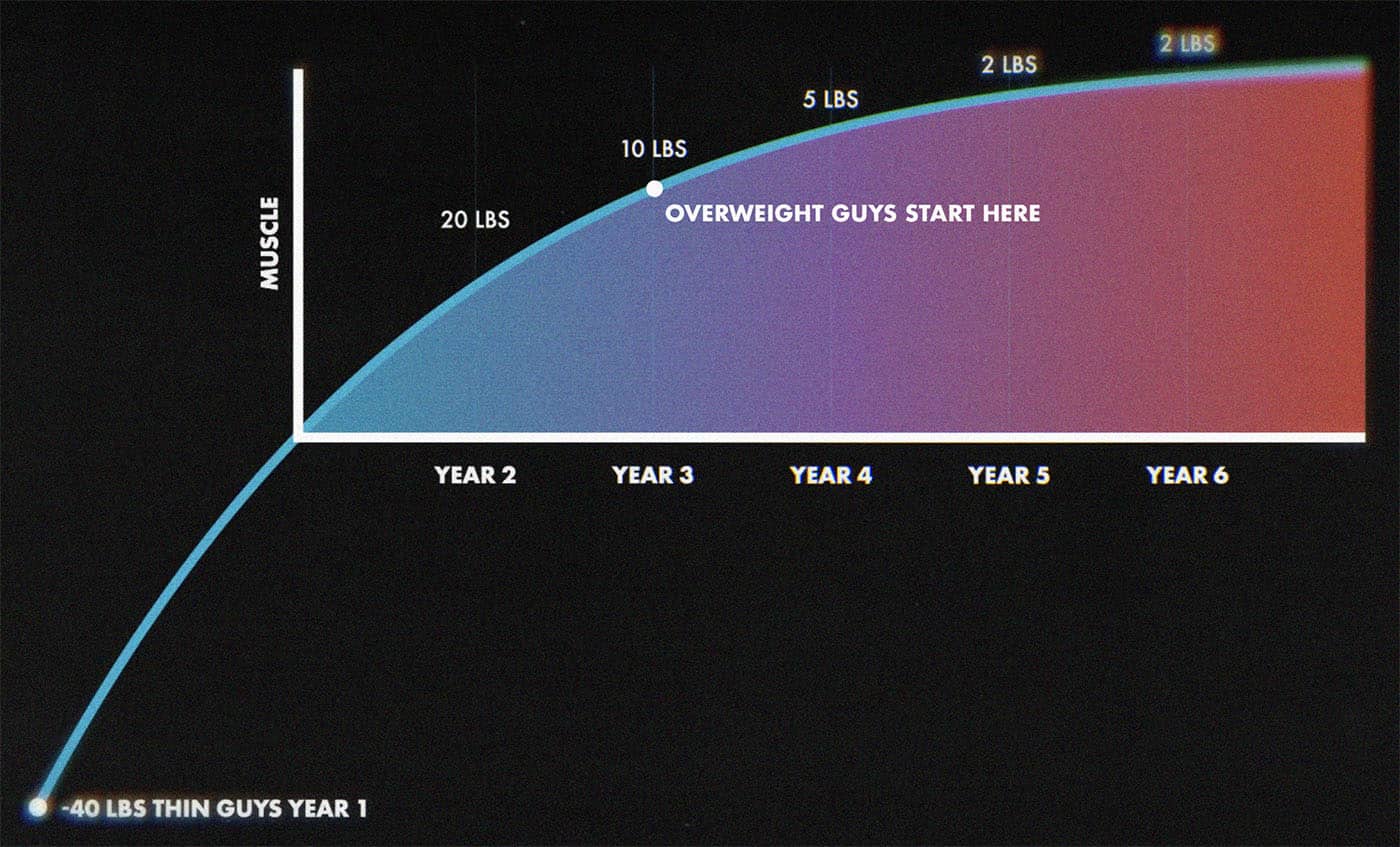
If you’re skinny, then there’s extra room on your frame for growth. Even if your bookshelf is small, it’s empty, so you can add a ton of books to it. (You can also make your bones slightly thicker, and you can greatly improve your bone density, allowing your frame to hold significantly more muscle. I’ll go deeper into that in another article.)
I confirmed this idea with Dr. Eric Helms, the bulking researcher Jeremy Ethier had in his video. I showed him my graph and explained my thinking, and he said he agrees. There isn’t much research specifically on skinny people, but he said what little research there is supports this idea.
I think the stronger evidence comes from the bulking tradition, though. The guy who encouraged me to bulk faster was my business partner, Marco, who studied under Eric Cressey, the strength coach for the New York Yankees. I think he got it from Dan John, who was famous for helping skinny football players bulk up a few decades ago.
Most strength coaches have seen skinny guys explode into their newbie gains when they start bulking properly. When I talk about this stuff with other muscle-building experts, we’re almost always on the same page.
With this in mind, the next mistake is especially bad.
Gaining at a Percentage of Body Weight
If you’re a skinny guy who’s trying to bulk up, Jeremy Ethier recommends gaining weight at a percentage of your body weight. This idea comes from one of Dr. Eric Helms’ studies. In that study, Dr. Helms argues that people with “normal” body compositions (not skinny or overweight) should gain 1–2% of their body weight per month:
| Novice/Intermediate | Advanced | |
|---|---|---|
| Monthly Weight Gain | ~1–2% of body weight | ~1% of body weight |
| Calories | +10–20% above maintenance | +5–10% above maintenance |
| Protein | 1.6–2.2 g/kg | 1.6–2.2 g/kg |
| Fats | 0.5–1.5 g/kg | 0.5–1.5 g/kg |
| Carbs | Remaining calories (≥3–5 g/kg) | Remaining calories (≥3–5 g/kg) |
This doesn’t do a very good job of telling any given person how quickly they should gain weight while bulking, but it works well enough when looking at large groups of people over long periods of time. It breaks when you use it with skinny people, though. For example, if you weigh 130 pounds, that’s 0.3–0.6 pounds per week. The upper limit is way too low. Even if you want to be conservative with your recommendations, better to bump the upper limit to 1 pound per week.
I spoke with Dr. Eric Helms about how his system doesn’t work properly for skinny guys, and he agreed.
This doesn’t perfectly account for people who are overweight to start and won’t be gaining weight at all, and it also doesn’t account for people who are underweight and can probably gain a disproportionate amount of lean mass relative to most people who start at that same bodyweight.
–Dr. Eric Helms
The reason Eric Helms recommends gaining weight at a percentage of our body weight is because, when you look at the population as a whole, differences in body weight are often explained by differences in frame size. A beginner who weighs 200 pounds (without being fat) is probably a fairly tall man, whereas a beginner who weighs 130 pounds (without being skinny) is probably a small woman.
If you’re skinny, then these recommendations won’t work properly for you, and they were never supposed to.
Jeremy Ethier’s recommendations are worse. In his video on body types, he cuts off the upper limit for skinny people, recommending that we gain just 1% of our body weight per month. If you weigh 130 pounds, that’s +0.3 pounds per week.
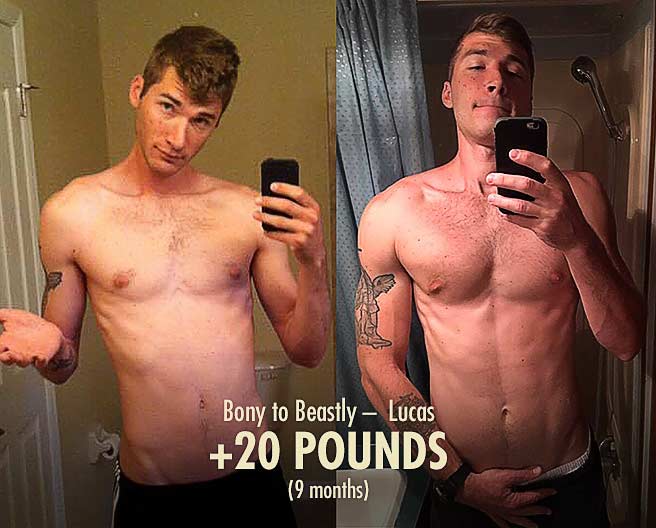
Even if you were doing a lean bulk, I’d still recommend bulking at twice that pace. It’s easier to bulk at twice that pace, too, because your calorie surplus has a larger margin of error. For example, here’s Lucas bulking at an average pace of 0.5–0.6 pounds per week, gaining 20 pounds in nine months:
Jeremy’s recommendation also defies basic logic. Skinny people tend to be able to build muscle faster, but they weigh less, so they’re being told to bulk slower. That’s exactly backwards.
Much better to look at how full your frame is. That’s what I do when I’m helping a b2B member figure out how fast to bulk. I’ve been doing it for 15 years. It works very well.
I was speaking about this with Greg Nuckols (a muscle growth researcher, and the founder of Stronger by Science, MASS research review, and Macrofactor) a little while back, complaining about this % of bodyweight system, and wondering if I should make a system that accounts for how much room is left on someone’s bone structure. Dr. Casey Butt already did the research on how frame size relates to muscular potential. You can get a good idea with a calculator like this one.
Greg agreed about the problem, but he proposed a simpler solution: “Baseline muscle mass doesn’t seem to be a particularly good proxy for how quickly people build muscle when they start training. For that reason, I actually tend to favor something even simpler – just raw pounds per week (instead of scaling to body size). But, since people are used to recommendations in terms of % of body weight per week (maybe the additional complication just feels more precise and scienc-ey to people? idk, really). But, I think that often hits peoples’ ears/eyes as being too simplistic.”
For our hypothetical 130-pound skinny guy who’s trying to build muscle quickly, Greg recommends gaining up to 1.3 pounds per week. That’s 20 pounds in 4 months.
That brings us to another problem. Jeremy Ethier never defined what he meant by “muscle.”
The Difference Between Muscle & Lean Mass
Muscle is more than just contractile tissue. It also includes the sarcoplasm, which grows in proportion to the myofibrils, so that’s fine. Where people get confused is with muscle glycogen, muscle swelling, and muscle creatine:
- Muscle glycogen: Glycogen is the sugary fuel you store inside your muscle cells. It’s inside your muscle cells. It makes your muscles bigger and harder, and it improves their performance. It 100% counts as muscle mass. It’s tricky, though, because it comes and goes. When you eat more calories and carbs, your muscles inflate with extra glycogen, often adding a pound or two of muscle in a week. If you’re starting off skinny or have just finished cutting, your muscles will be unusually low in glycogen, which means they can inflate even more dramatically.
- Muscle swelling: When you lift weights, your muscles swell up with extra blood and fluid. This is called a “muscle pump,” and it lasts for an hour or so. However, your muscles will stay somewhat inflated for a few days, while they’re growing bigger. That’s why, if you’re lean enough to see your muscles, you may notice that you look more muscular in the 2–4 days after working out. That means that if you work out every 2–3 days, your muscles will always be kinda pumped up. If you take a vacation from lifting, the swelling will fade, and you might worry you’ve lost muscle mass. You haven’t, though. It’s just the swelling finally fading away.
- Muscle Creatine: If you start supplementing with creatine, your muscles will start storing more creatine, which can add a few more pounds of weight. It’s common to gain 2–3 pounds during your first month of supplementing with creatine, but it’s possible to gain 7+ pounds. Creatine is a plant-based supplement, but the richest dietary source is meat. So, if you haven’t been eating much meat, your creatine levels might be low, and you might have an especially dramatic response to supplementing with creatine. Creatine also speeds up your rate of muscle growth, perhaps by as much as 30%, but those extra gains are more gradual, and they won’t fade away when you stop taking creatine, so it’s less confusing.
These gains are mostly fluid, but that’s how all muscle is. Think of the difference between a steak (a muscle rich in fluid) and a piece of beef jerky (a dried muscle). When we think of our muscles, we’re considering the full muscle, including the fluid. That’s what researchers do, too.
Lean mass is more than muscle. When people talk about gaining “muscle,” they’re usually counting everything that isn’t fat. If you gain 20 pounds on the scale with 0 pounds of fat, most guys will say they’ve gained 20 pounds of muscle. That’s mostly true, but they’ve also gained:
- Gut contents: Eating more food means more food in your digestive system, bumping up your weight on the scale (and slightly increasing your waist measurement). That means that every time you bump your calories up, you might get a little boost on the scale.
- Salt and hydration: When you eat more sodium, your body will hold more water, and then it will adjust. If you start eating more food, that usually means eating more salt, so you might temporarily gain some fluid weight as your body adjusts. Or, if you clean up your diet, you might be eating less salt than usual, so you might lose a bit of fluid weight. (The extreme version of this is when you see an MMA fighter sweat out 20 pounds of water to make weight for a fight, then rehydrate, immediately gaining back those 20 pounds of lean mass. That has nothing to do with bulking, though.)
- Connective Tissues! When you get bigger and stronger, you also get denser and tougher. Your skin, tendons, and bone grow along with your muscles, making you more robust, and adding a little bit of weight to the scale. These gains are super cool—easily as exciting as the muscle gains—but they’re small and gradual, so they aren’t very confusing.
And then some guys include some of their fat gains, too. For example, if they gain 20 pounds on the scale while staying at 15% body fat, they’ve gained 17 pounds of lean mass and 3 pounds of fat, but they might still call it 20 pounds of muscle. It’s deceptive because as your muscles grow bigger, you’ll have better muscle definition at the same body fat percentage, so it might even look like you’re losing fat, even while you’re gaining it.
In Jeremy Ethier’s video, he shows a picture of himself at 160 pounds and 180 pounds, saying that he gained 20 pounds of muscle. If I had to guess, it seems that he’s counting everything as muscle—all of the lean mass and fat mass he gained. And I don’t really have a problem with that. I think it’s fine to talk casually about gaining “muscle,” especially if it looks and feels like muscle. But it makes his argument impossible to defend.
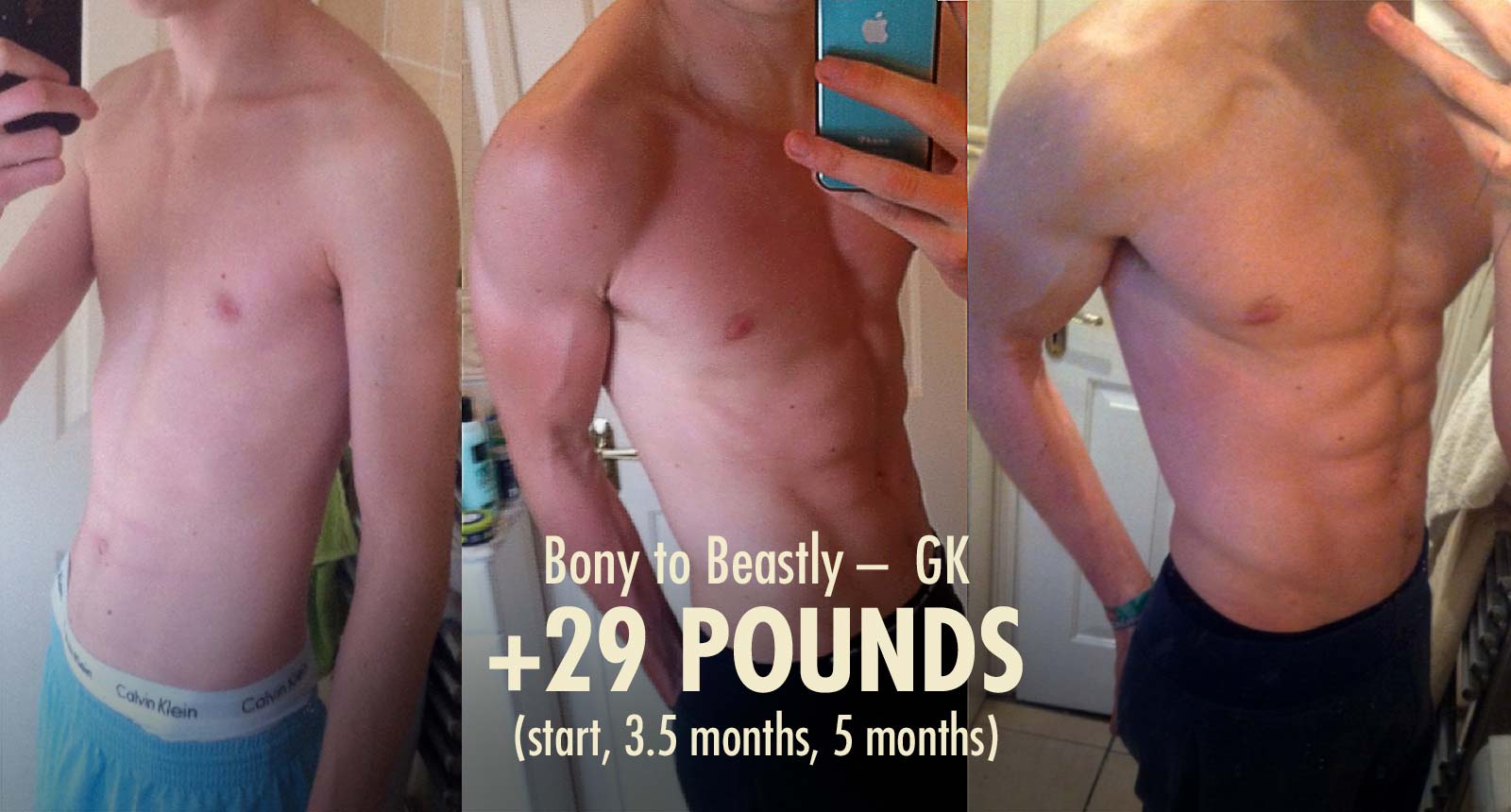
If muscle is weight gained on the scale in a way that looks lean, then it’s easy for me to show examples of guys gaining 20 pounds of “muscle” in well under a year. For example, here are GK’s progress photos:
What’s more important, though, is to understand what the “shape” of a good bulk looks like.
Start Fast, Finish Slow
A proper bulk starts fast and then slows over time. When I gained those 25 pounds in 3 months, I gained about 12 pounds in the first month, a little over 5 in the second, and just under 5 in the third. I was trying to eat enough food to gain a pound per week, but I graciously accepted the faster gains earlier on as I swelled up with food, blood, glycogen, and creatine, and then I had some smaller weeks toward the end. My calorie surplus was about the same throughout.
If a beginner starts bulking aggressively, he’ll fill up his digestive system with food, and his body will pack his muscles full of extra glycogen and creatine, and his muscles will swell up from the training, so he might gain 2–3 pounds of pure lean mass in his first week, with most of that mass being in the muscles (extra glycogen, creatine, and muscle swelling). He might gain another 2 pounds of lean mass in his second week, maybe another 1.5 pounds in his third week, and then settle down into a steadier rate of muscle growth, gaining about a pound per week for a couple more months, with those gains gradually slowing over time. By the time he’s at month 6, he might be gaining 0.5 pounds per week, and pushing it higher would just cause fat gain.
That’s why it’s fairly common for an 8-week bulking study to show 8 pounds of lean mass gains. That’s a tremendous, seemingly impossible rate of muscle growth… until you consider that during the first few weeks, their muscles are inflating and swelling, pulling in energy and fluid.
When we extend the timeframe, the weekly rate of muscle growth slows.
We want a curve that slows over time.
Jeremy Ethier’s Accelerating Bulk
Jeremy Ethier recommends speeding up as you get deeper into your bulk, which doesn’t make any sense. Your rate of muscle growth slows as you gain muscle, so when you’re bulking, you should start off faster and then slow down over time.
If you weigh 130 pounds, and you gain 1% of your body weight in your first month, that means you start your bulk at 0.3 pounds per week. Not only is that much slower than it needs to be, but your rate of weight gain starts gradually accelerating:
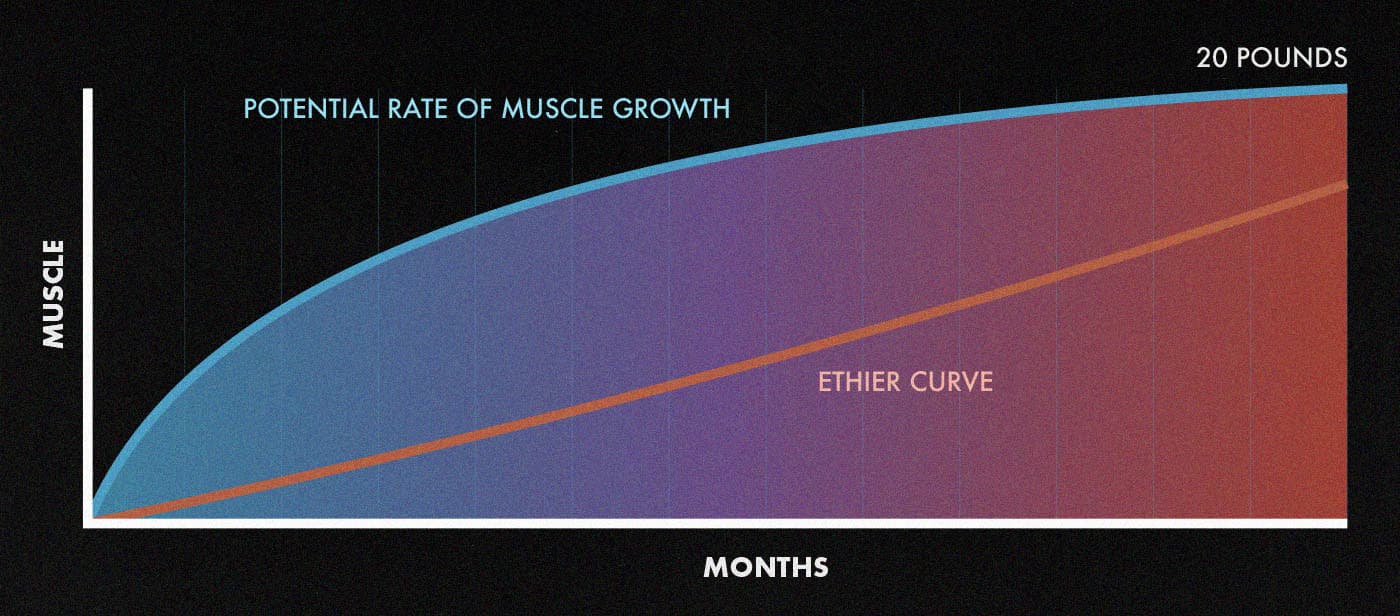
By the time you’re at month 11, the Ethier method has you gaining 0.4 pounds per week. That’s still much slower than it needs to be, so it’s not like you’d be getting fat, but you’re curving your gains the wrong way. You’re missing out on the exciting period of explosive growth at the beginning of your bulk!
And remember, Jeremy’s video is “The Fastest Way to Gain 20 Pounds of Muscle Naturally.” The whole point of the video is to teach guys how to maximize their rate of muscle growth.
Why Jeremy Ethier’s Bulking Advice Fails
The reason Jeremy Ethier doesn’t have any examples of skinny clients gaining 20 pounds of lean mass in under a year is because he’s needlessly limiting their rate of muscle growth. If you’re telling skinny guys to gain 10–20 pounds per year, it’s unlikely you’ll have clients gaining 20 pounds in 6 months.
The problem goes deeper, though. As I explained in this article, my audience is almost entirely made up of formerly skinny guys. I surveyed them a little while back to see which bulking methods had worked best for them, and quite a few of them told me they had tried Jeremy Ethier’s bulking program, liked how the information was explained, but then failed to gain any lasting muscle.
The problem is that the average person is overweight, so the typical healthy eating advice is designed for people trying to lose weight. Jeremy gives that same advice to skinny guys trying to bulk up. He’s mixing weight-loss tricks into his weight-gain advice. That makes it much harder to gain weight.
And again, Jeremy Ethier doesn’t show any examples of any of his clients bulking at all. In his video, he shows two examples of skinny guys bulking up. The first is a real skinny guy with a AI-generated progress photos. The second is a fully AI-generated skinny guy. Both bulking examples are fake.
The Lean Bulking Trap
Some of the gains you make are transient. If you want lasting progress, you need to push deeper. And if you’re bulking very slowly, that means bulking for at least a few months, and ideally even longer. If you’re gaining a pound or two per month, and if your body can inflate with 5–10 pounds of glycogen, swelling, and creatine… then you might not gain much lasting muscle during your first few months. That’s especially true if you’re starting off lean or skinny, with no extra body fat to burn for energy.
Here’s how it might look:
- The skinny guy who bulks more aggressively might be at +20 pounds by week 20, with 12 of those pounds being muscle, 5 being miscellaneous lean mass, and 3 being fat. He takes a break from bulking, loses 5 pounds of fat and fluid, and settles at +15. He’s made huge strength gains on all of his exercises, he feels sturdy and strong, and he’s picking up compliments on his transformation.
- The skinny guy who bulks slowly might be at +7 by week 20, and 5 of those pounds might be transient fluid gains. If he stops bulking, he might only keep 2 of those pounds, without much extra strength to show for it. That can feel discouraging.
What sucks is that the lean bulker is on the right path. He’s got all of the right habits. If he bulks for another 6 months, he’ll finish in a great spot. But it’s very rare for a beginner to be able to bulk for 12 months straight. And if his first 6 months weren’t encouraging, he might be reluctant to try again.
The classic bulker needs to watch out, too, though. If he keeps pushing fast, he’ll start gaining proportionally more fat as he drives deeper into his bulk. If he keeps it up for a full year, he might finish with a bigger waistline than he wanted. Not enough to cause a health problem, and there’s no lingering harm. But it’s not the dream, either.
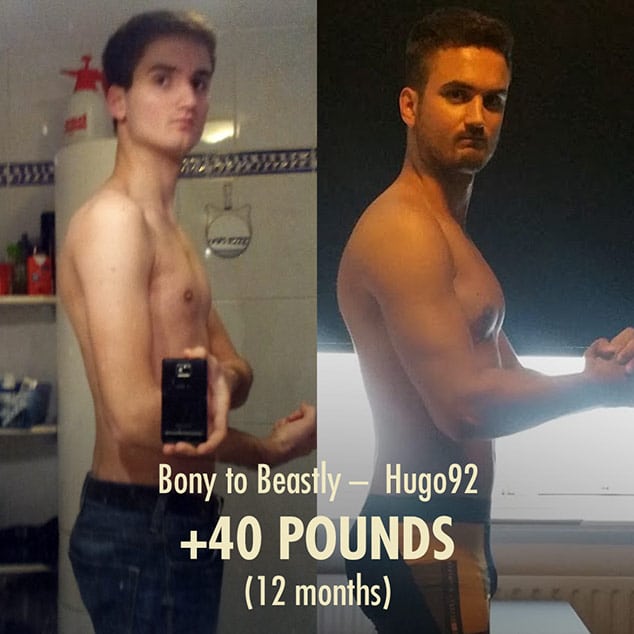
That’s why you can’t expand a classic bulk out to a yearlong timeframe. Gains aren’t linear like that. It’s fairly common to gain 20 pounds of mostly lean mass in 20 weeks. It’s much rarer to gain 40 pounds of mostly lean mass in 40 weeks. That only happens when someone starts off quite thin and is unusually persistent. I’ve helped clients do it, but it’s a remarkable effort over a long period of time.
I think it’s better to plan a 3–6 month bulk, see how things are going, get a full evaluation (like we do with members), and adjust from there.
Alright, that’s it for now. I’m working on an article/video about improving muscular potential by building stronger bones, but I also want to write an article about how fast you should bulk if you’re not skinny. More to come soon!
Best,
Shane
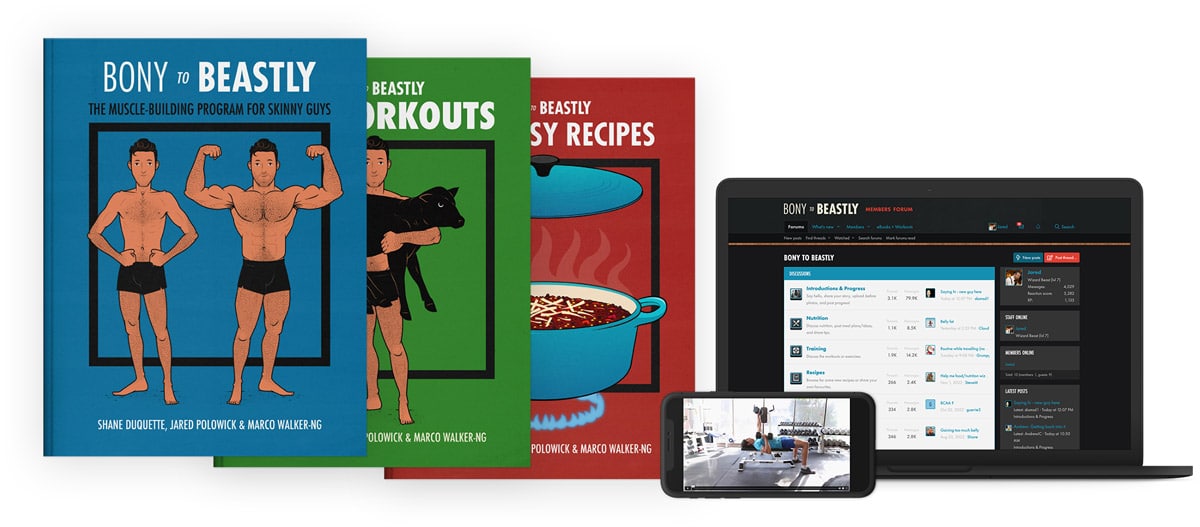
If you want my help bulking up, The Bony to Beastly Program is our foundational bulking program for skinny guys. The program is perfect for guys with less than two years of lifting experience, for guys who are still thin or skinny-fat, and for guys who haven’t yet gained their first 20–30 pounds of muscle yet.
We’ll teach you everything you need to know about muscle growth, fat loss, body recomposition, health, and fitness. And we’ll guide you through the full program, helping you track your progress, answering all your questions, and giving you personal advice as you go. As long as you put in the work, I’m happy to guarantee 20 pounds in 20 weeks.

Shane Duquette is the founder of Outlift, Bony to Beastly, and Bony to Bombshell, each with millions of readers. He's a Certified Conditioning Coach (CCC), has gained 70 pounds, and has over a decade of experience helping more than 15,000 people build muscle. He also has a degree in fine arts, but those are inversely correlated with muscle growth.