
The Low-Volume Myth: Fewer Sets, Higher Intensity?
I found this research super interesting and counterintuitive. I think you might, too. I’ve been keeping up with all the important new hypertrophy studies for almost two decades now, and I remember these papers coming out, remember reading through the reviews, hearing the discussions about them. Still, going through them one after the other like this has changed how I think about training volume, failure, and fatigue.
What follows is part of the guide that comes with the Commando Program, but you can apply these principles to any program.

I wanted to go through the research again, looking for a combination of a few things. Commando is going after:
- Great gains
- Amazing health
- Awesome aesthetics
- Shorter workouts
- Less fatigue
Those last two points are an unusual combination. If you’ve seen the viral videos of Mike Mentzer, you know what I mean. He recommended doing just 1–2 sets per exercise, pushing so hard your soul flees your body, and leaving the gym so incredibly spent that you can’t train again for several days. It was the hardest of all hardcore training.
I would say the method failed him. By the time he came up with this system, he’d already gained most of his muscle from a more traditional approach. To continue gaining muscle, he paired his new methods with cocktails of dangerous drugs (hardcore stimulants and steroids). He then ran into health problems and died tragically young.
Yet, strangely, his old training lectures have become incredibly popular on TikTok, Instagram, and in YouTube shorts, such that most modern low-volume bodybuilding programs are built on top of his methods.
It gets weirder when we look at the research.
Fatigue is usually a decent proxy for muscle growth, but in this case, training with such a high level of effort seems to bring fatigue without stimulating extra muscle growth.
I don’t have anything against fatigue. I think it’s good to work hard and go to bed tired. When we challenge our vigour system, we adapt by gaining more vigour. But when people want shorter workouts, they typically want those workouts to be less fatiguing and more stimulative. They want great gains while still having energy to spend on other things.
So how do we do that?
Moderately Low Volume
Commando has you lifting 2–5 days/week, aiming for ≈6 sets per muscle per week when doing 3 workouts/week. You can push the volume higher by doing 4–5 workouts per week. There are diminishing returns, but you’ll still get returns.
The workouts are also efficient enough that you should be able to maintain your gains with 2 workouts per week, giving you around 4 sets/muscle. If you’re an intermediate lifter, you may even be able to make slow progress.
To give you an idea of what this looks like, I tallied up the fractional volume, with a full unit of volume for sets that work a muscle maximally (e.g. pecs in the bench press) and half a unit for sets that work them sub-maximally (e.g. triceps in the bench press).
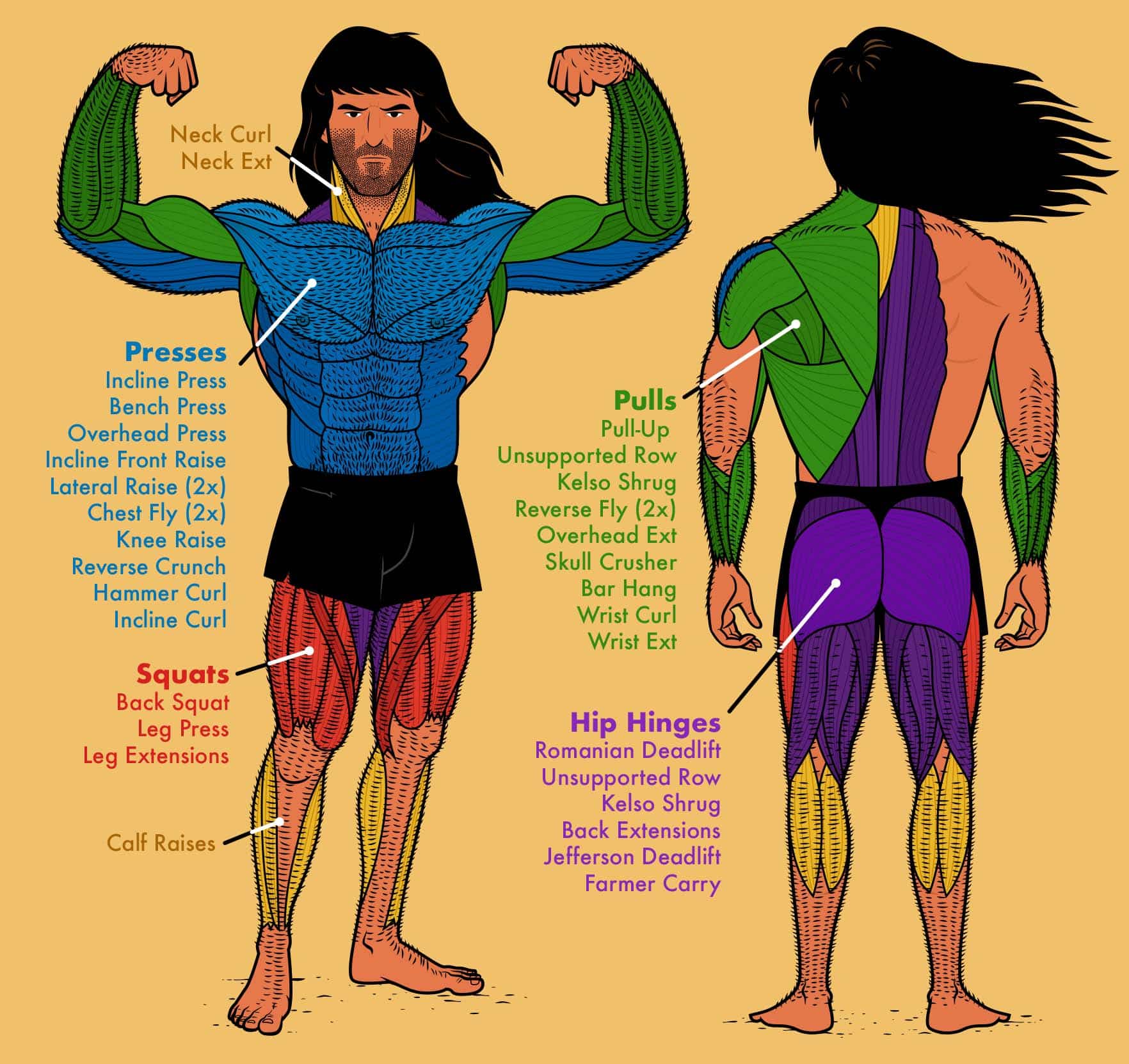
We also considered your forearms, neck, calves, core, as well as how different pulling exercises train the different muscles in your upper back, and so on, but here’s a simple tally for some of your bigger muscles groups, assuming a pace of 3 workouts/week:
- Chest: 8 sets
- Upper Back: 8 sets
- Biceps: 7 sets
- Triceps: 7 sets
- Posterior: 5 sets
- Side Delts: 5 sets
- Quads: 5 sets
- Glutes: 5 sets
- Hamstrings: 4 sets*
This is on the threshold between low and moderate volume. It’s low for the lower body and moderate for the upper body. The volume is ≈33% lower than most of our programs, and the workouts take half as long—about 40 minutes.
Some people can get good gains with ≈4 sets per week. It’s not as consistent, though, and we wanted to give you a program you could count on. There’s no doubt that 6ish sets are enough volume to get solid, highly efficient results. You’ll see what I mean in the next section.
*It’s easy to hit your hamstrings hard in a deep stretch. Most advanced lifters find that 4 sets is plenty. That’s often true with the chest as well, but we want especially great chest gains.
Lower Volume, Same Effort
What you’ll often hear is that when you do fewer sets, you need to push harder… but is that actually true? I’ve been reading through this research for a while now, and I’ve been paying attention to how the best natural lifters have been training. I had a feeling this assumption might be wrong. So I checked.
Commando is a program for intermediate and advanced lifters, and it has you doing ≈6 sets per week, so I looked specifically for studies that had trained lifters doing about ≈6 sets per muscle per week.
This article by Greg Nuckols was extremely helpful. I also dug through the MASS research review to find more recent research.
I found quite a few relevant studies, and I’ll go through all of them, starting with these 5:
- In this 2016 study by Pareja-Blanco, one group trained their quads with 6 sets per week to about 0 RIR, occasionally hitting failure by accident. The other group stayed several reps shy of failure. The difference wasn’t statistically significant, but the group that trained close-but-not-all-the-way to failure grew quite a lot more (7.7% vs. 4.6%).
- In this 2019 study by Carroll, they gathered men with ≈8 years of lifting experience. They did 6 sets of squats per week, either to failure or with ≈3 RIR. The group that took their squats to failure gained less muscle than the ≈3 RIR group (8.8% vs. 3.2%).
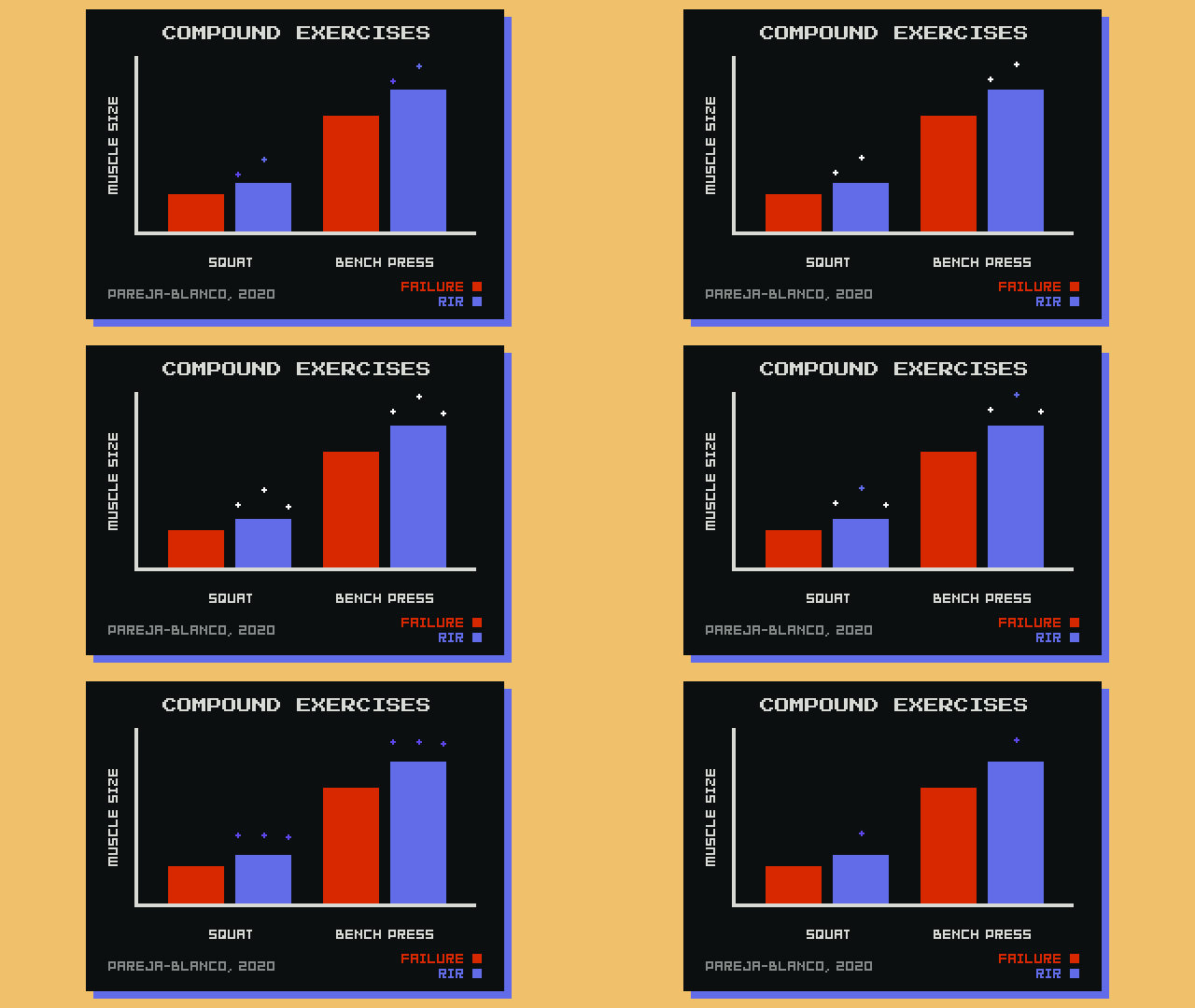
- In 2020, Pareja-Blanco conducted a follow-up study, with 6 sets of squats per week, this time comparing lifting close to failure vs all the way to failure. The group that stopped just shy of failure gained slightly more muscle (7.0% vs. 5.3%).
- And then another 2020 Pareja-Blanco study, this time doing 6 sets of the bench press, again comparing close to failure vs failure, and again finding greater growth from stopping just shy (20.3% vs. 16.5%).
- In a 2021 study by Karsten, one group of experienced lifters trained their quads with 4 sets to failure per week, and the other group did 8 sets with 5 RIR. The group doing 4 sets to failure gained way more muscle, even though they were only doing half as many sets (5.9% vs. 0.6%).
These studies all show trained lifters growing impressively well from 6 sets per week, as long as they trained with 0–3 RIR. If you’re training with 5 RIR, you aren’t pushing hard enough to stimulate much growth.
None of this is specific to low-volume training. However many sets your hypertrophy training program has, you’ll almost always be told to train with 0–3 RIR. Easier sets are for warming up or building maximal strength.
Interestingly, if you try to make up for doing fewer sets by pushing to total failure, you may do slightly worse. Sort of. These studies were on seasoned lifters doing compound exercises. What about beginners? What about isolation exercises?
Isolation Exercises
Isolation exercises are a different beast. I found two studies that used a relevant number of sets/week, both were conducted on beginners, and both found better results from doing fewer sets to failure:
- Goto found 4x as much quad growth from doing fewer sets of leg extensions to failure (12.9% vs. 4.0%).
- Martorelli found 2x more biceps growth from doing 3 sets of biceps curls to failure than from doing 4 easier sets (17.5% vs 8.5%).
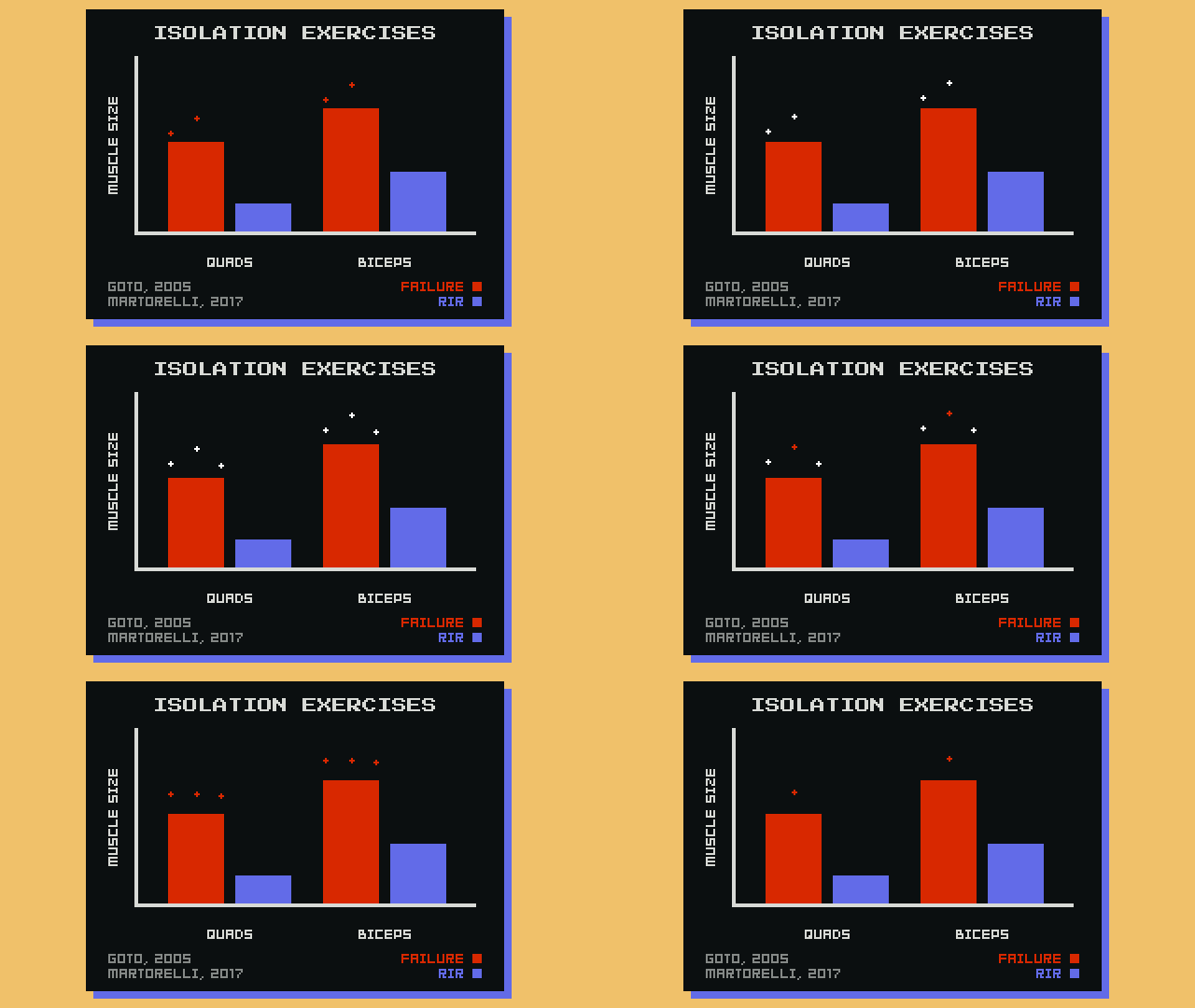
This research is more interesting than it seems. Beginners aren’t as good at recruiting all of their muscle fibres, so it makes sense they’d gain more muscle from training all the way to failure… but Lacerda and colleagues found that beginners gained more muscle from stopping their compound exercises shy of failure, just like trained lifters (study). I think we may be seeing a true difference between compound and isolation exercises.
Your body tries to be efficient with its energy. With a bench press, your pecs are in the best position to move the weight, so your pecs work very hard very early. As you get closer to failure, your chest fatigues, and it can’t produce as much force, so it shunts the work to your shoulders and triceps. By the time you’re hitting failure, you’re using very little chest, more shoulder, and more triceps.
You’ll also notice that as you get closer to failure, you can’t move the weight as quickly. You’re still trying to move the weight quickly—or at least you should be–but your muscles are fatiguing, and they can’t generate as much tension anymore, so the rep slows.
Tension is the main driver of growth, and tension decreases as you get deeper into a set, so that final push to total failure appears to have less potential to stimulate growth—at least on compound exercises.
With an isolation exercise, though, you’re lifting less weight with fewer muscles. To fully work the muscle you’re trying to work, you may need to train very close to failure. That would explain why people grow faster when they take their isolation exercises to failure.
There are stranger implications. When you train in lower rep ranges, the weight is heavy enough that your body needs to use your primary and supporting muscles right from the very beginning. Maybe compound exercises are the most compound when they’re heavy.
Similarly, if you bring a moderate-rep set of bench press to failure, the final 1–2 reps might not stimulate your chest, but it’s possible they stimulate your shoulders and triceps. It’s hard to say because the researchers didn’t measure the secondary muscles. That means if you like bringing your compounds to failure, you have an excuse.
With a program like Commando, I suspect you’ll get the best gains from doing big, heavy compound exercises for a couple sets of 5–10 reps with 0–2 RIR, without intentionally pushing to failure. That will efficiently stimulate great growth in both the primary and secondary muscles without creating needless fatigue.
On isolation exercises, we can get greater growth from pushing harder. And isolation exercises aren’t as fatiguing, so no problem.
That brings us to fatigue.
Fatigue
The biggest meta-analysis found that stopping shy of failure makes workouts feel easier while doing them, leaves you less tired right afterwards, and creates less fatigue in the following days. Every single study in the meta-analysis supported the findings. Importantly, failure had a much bigger effect on fatigue than volume did. Doing half as many sets to failure was more fatiguing than doing twice as many sets with a couple of reps in reserve.
This is important because it tells us that if we’re trying to free up energy, there’s more to be gained from stopping shy of failure than from doing fewer sets. The Mike Mentzer thing where you hype yourself up on stimulants and destroy yourself on every set is one of the most fatiguing ways you could possibly train.
Even stopping at 0 RIR, ending your set when you don’t think you’d be able to get another rep, is much less fatiguing than fighting for that extra partial rep and hitting true failure. Freeing up that tiny bit of RIR might not sound like much, but it seems to stimulate more growth with less fatigue.
Anecdotally, stopping shy of failure also seems to reduce the risk of getting annoying little injuries. It’s common for guys to, for example, strain their trap when trying to bring an overhead press to total failure. I’ve strained my quad while trying to leg drive the final rep of an already-failed bench press. My pec strength was long exhausted, and I was in a poor position to use my other muscles.
Another common mistake is to lift lighter weights for more reps. Lifting lighter sounds like it ought to be easier and less fatiguing, but it’s the reverse. Participants tend to report that lifter heavier weights is less painful, leaves them feeling less tired, and creates less fatigue. This is well-known among lifters. Higher-rep sets of squats are called “widowmakers” because of how viciously painful and fatiguing they are.
Or think of a bootcamp sort of workout where you have to do a bunch of light sets of push-ups or goblet squats to failure. The last 5–10 reps of each set hurt like crazy, you need to use all your willpower to power through them, and you finish feeling fatigued. You may dread the next workout.
Some people like that style of training, in which case those problems disappear. It doesn’t cost willpower to do what you like, and fatigue isn’t unhealthy. Aside from most people not liking it, there’s nothing actually wrong with doing painful, tiring workouts. It isn’t simpler, easier, or more productive, though.
As a general rule of thumb, if you want to increase muscle growth, preserve willpower, and reduce fatigue, you want to:
- On compound exercises, keep the rep ranges on the lower side of the hypertrophy rep range. Maybe 5–11 reps per set. Maybe 0–3 RIR.
- Smaller isolation exercises aren’t as fatiguing, so you’re free to bump the reps up and push harder. Maybe 7–15 reps per set. Maybe 0–1 RIR on the first set, 0 RIR or failure on the last set.
This should give us the best of all worlds. More enjoyable workouts that demand less willpower, feel easier, give us the most growth per set, and leave us feeling less fatigued.
==> Commando Program (Launch Bundle)
If you want to try Commando, we have a special launch bundle. It comes included with our Barbarian and Bonemaker programs, as well as our bulking, cutting, and recomp guides. And it includes personal support and feedback from us. We’ll personally make sure you get great results.

Shane Duquette is the founder of Outlift, Bony to Beastly, and Bony to Bombshell, each with millions of readers. He's a Certified Conditioning Coach (CCC), has gained 70 pounds, and has over a decade of experience helping more than 15,000 people build muscle. He also has a degree in fine arts, but those are inversely correlated with muscle growth.
Muscle-Building Mini-Course via Email
Sign up for our 5-part muscle-building mini-course that covers everything you need to know about:
Here are some related articles